

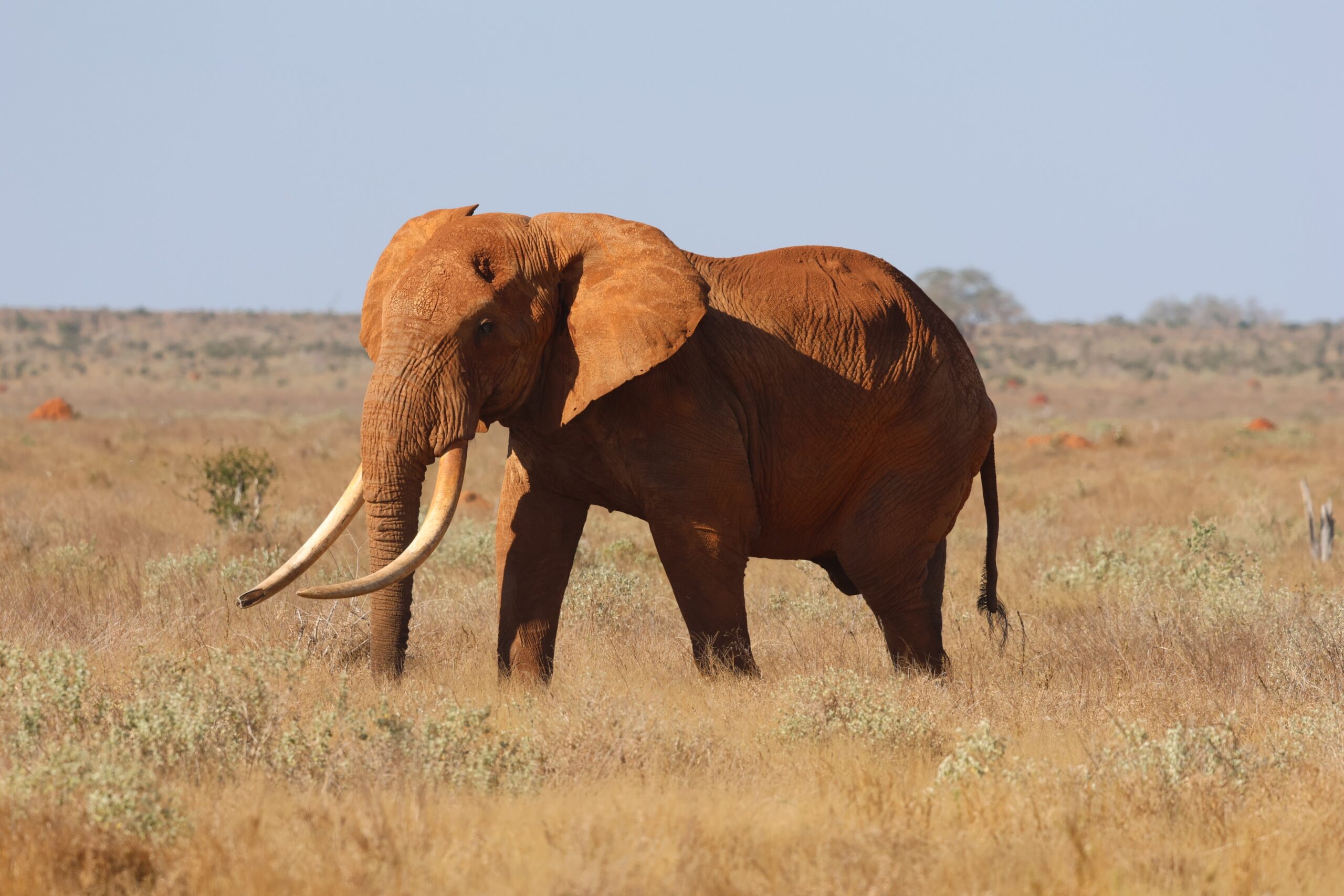
Across Africa, elephants with truly enormous tusks have become exceptionally rare. Known as Super Tuskers, these individuals represent the extreme upper end of natural tusk growth. Their tusks can each weigh more than 45 kilograms and often grow so long that they nearly touch the ground.
Today, it is estimated that only around 20 to 30 Super Tuskers remain in the world. Of these, approximately 12 are monitored within the Tsavo Conservation Area, with a further 9 to 10 individuals found in the Amboseli ecosystem.
Yet while many elephant populations have lost these giants, Tsavo remains one of the last places on Earth where they still persist.
The question is simple: why Tsavo?
What is a Super Tusker?
A Super Tusker is typically an older bull elephant whose tusks exceed 100 pounds each. These tusks are not just large, they are the result of decades of growth, survival, and access to resources. Only bulls can be Super Tuskers, but there are female elephants with huge tusks that don’t quite reach 100lbs. We call these Iconic Cows.
Tusks grow continuously throughout an elephant’s life. To reach this size, an individual must not only possess the right genetics, but also survive long enough to realise that potential. Most, if not all, Super Tuskers are over 40 years old. As an elephant gets older their tusks begin to grow faster. For elephant above 40 years old, their tusks grow at a whopping 7 cm per year.
Super Tuskers are therefore rare not just because of their size, but because they represent a combination of genetics, age, and long term survival.

Why Super Tuskers disappeared elsewhere
The rarity of Super Tuskers today is largely the result of historical hunting.
For centuries, elephants with the largest tusks were selectively targeted during the ivory trade. Larger tusks meant higher value, and so the biggest individuals were removed first. Over time, this created strong selective pressure against large tusks.
In many regions, this had lasting genetic consequences. Populations began to show smaller tusks, and in some cases, a higher frequency of tuskless elephants. The individuals most capable of becoming Super Tuskers were systematically removed before they could pass on their genes.
Although international bans on ivory trade have reduced large-scale legal trafficking, the legacy of this selective pressure remains. In most ecosystems, elephants simply no longer live long enough, or carry the genetics required, to become Super Tuskers.
Why Tsavo still has them
Tsavo’s ability to support Super Tuskers comes down to a combination of scale, protection, and continuity of genetics.
First, the landscape itself is vast. The Tsavo Conservation Area is one of the largest protected ecosystems in Africa, allowing elephants to move freely across a wide range of habitats. This space reduces pressure and provides access to diverse resources, particularly important during dry periods.
Second, Tsavo has remained relatively intact compared to many other ecosystems. While it has faced its own challenges, it has retained large, connected habitats that allow elephant populations to function naturally.
Third, protection efforts have been sustained and increasingly effective. Collaboration between Tsavo Trust and the Kenya Wildlife Service has strengthened monitoring and response capacity. Aerial surveillance, ground patrols, and real-time tracking of key individuals all contribute to reducing risk.
This combination of space and protection allows elephants to survive long enough to reach exceptional size.
The role of genetics
Super Tuskers are not a separate type of elephant. They are individuals expressing a rare genetic potential.
For these traits to persist, elephants must be allowed to reach old age, reproduce, and pass on their genes. In ecosystems where large tuskers were heavily targeted, this genetic potential has been reduced.
In Tsavo, enough individuals survived for these traits to remain within the population. The presence of Super Tuskers today is therefore a reflection of both past survival and present protection.

Why age matters
Tusks grow continuously throughout an elephant’s life, meaning size is directly linked to age.
A bull may take decades to develop truly massive tusks. Any interruption to that lifespan, whether through poaching, conflict, or environmental stress, prevents that potential from being realised.
Super Tuskers are therefore not just large elephants. They are old elephants, and their presence indicates that individuals are surviving for long periods in the wild.
A shrinking global population
The global decline of Super Tuskers is stark.
In South Africa’s Kruger National Park, a group of iconic bulls known as the Magnificent Seven once represented some of the largest tuskers in the region in the 1980s. Today, all of these individuals have passed away. While a number of elephants in Kruger are now recognised as emerging tuskers, there are currently no confirmed Super Tuskers remaining in that ecosystem.
This pattern reflects a broader trend. Across much of Africa, the conditions required for elephants to grow to such size no longer exist.
The importance of protecting Super Tuskers
Super Tuskers are more than just impressive animals. They play an important role in both ecology and conservation.
Ecologically, large bulls shape landscapes through their feeding behaviour and movement. Genetically, they represent traits that have been heavily reduced elsewhere.
They are also powerful symbols. Super Tuskers show what elephants can become when allowed to live without sustained human pressure. They are living indicators of conservation success.
The role of Tsavo Trust
In Tsavo, the continued presence of Super Tuskers is closely tied to active conservation.
Tsavo Trust supports elephant protection through aerial monitoring, ground operations, and collaboration with the Kenya Wildlife Service. Known individuals are closely tracked, allowing for rapid response to threats.
These efforts help ensure that elephants not only survive, but are able to live long enough to reach their full potential.
Ongoing threats
Despite progress, Super Tuskers remain vulnerable.
Poaching has not been eliminated. Human–wildlife conflict continues to pose risks, particularly during drought when elephants move beyond protected areas. Climate variability is also increasing pressure on both elephants and their habitats.
Protecting Super Tuskers requires sustained effort and long-term commitment.
Why Tsavo matters
Tsavo is one of the last strongholds for Super Tuskers and one of the few places where these giants still persist in meaningful numbers.
Today, 12 Super Tuskers are regularly recognised and monitored within the Tsavo ecosystem, alongside approximately 32 emerging tuskers that represent the next generation of these extraordinary elephants.
This is significant. It means Tsavo is not only protecting the last of these individuals, but actively sustaining a population where this rare genetic trait can continue into the future.
In many parts of Africa, these giants are now gone. In Tsavo, they are still present, and critically, still emerging.
Final thoughts
Super Tuskers are rare because history removed most of them.
They persist in Tsavo because enough individuals survived, and because the conditions now exist for elephants to reach their full natural potential.
Today, Tsavo stands as a genetic stronghold for Super Tuskers, safeguarding one of the last remaining populations where these extraordinary traits still endure.
In Tsavo, elephants can still grow old. And when they do, they can still become giants.