

Visitors to Tsavo often notice elephants with dark streaks running down from between the eye and the ear. This fluid comes from a specialised gland known as the temporal gland, unique to elephants. These secretions, known as Temporal Gland Secretion (TGS), play important roles in elephant communication and may signal different emotional or physiological states, including excitement, musth, and stress. Recent research has begun to reveal more about what triggers these secretions and what they tell us about elephant behaviour and well-being.
What and where is the temporal gland?
The temporal gland is located midway between the eye and the ear on both sides of an elephant’s head. It is a modified apocrine sweat gland that produces a thick, oily secretion. This secretion contains compounds such as cholesterol, phenol, cresol, and farnesol, chemicals thought to play a role in communication. Its composition varies between individuals depending on their age, sex, and sexual state. When the gland is active, it produces visible dark streaks that run down the elephant’s face.

What causes the gland to leak?
Temporal gland secretion occurs in both male and female elephants, but for different reasons. Among males, TGS is most often associated with musth—a period of heightened reproductive activity and hormonal change. Among females, it can be linked to stress, excitement, pregnancy, labour, or even joyful social reunions. The presence of the secretion, therefore, doesn’t always indicate aggression; it may reflect emotional stimulation or heightened physiological activity.
Musth: the male elephant’s hormonal surge
Musth is a natural reproductive phase in mature bulls marked by a sharp rise in testosterone levels, temporal gland secretion, and urine dribbling. During this time, bulls become more dominant and active, using scent to communicate their condition to other elephants. The secretion contains compounds such as frontalin, which acts as a pheromone, signalling both reproductive readiness to females and dominance to rival males. Younger bulls produce sweeter, “honey-like” scents thought to indicate submission to older, more dominant males—a strategy to avoid conflict. Musth is an essential part of elephant biology and a key driver of natural breeding behaviour.
Females and TGS: more common, less understood
While musth often attracts attention, studies have shown that female elephants actually display TGS more frequently, and for more varied reasons. Research by Kioko et al. (2017) found that females are significantly more likely than males to exhibit TGS. The likelihood of secretion increases with age and is affected by group dynamics. In larger family groups, females were less likely to show TGS, suggesting that social support reduces stress. Conversely, in larger male groups, TGS became more common—possibly due to competition or musth-related behaviours.
For female elephants, triggers of TGS include stress from calf-rearing, excitement during reunions, or environmental pressures such as human disturbance. It may also appear during pregnancy and birth, times of high energy demand and emotional strain. This indicates that TGS in females reflects both emotional state and social complexity within elephant families.
TGS as a form of communication
Temporal gland secretions are rich in chemical signals, suggesting that elephants use them for multiple communication purposes. These may include indicating reproductive state or readiness, reinforcing social bonds, expressing stress or alarm, or helping elephants locate one another across long distances through scent. Some researchers propose that TGS works alongside elephants’ low-frequency rumbles and infrasound communication, forming a complex and nuanced system of social exchange.
What TGS tells us about elephant stress and welfare
Findings from Kioko et al. (2017) show that TGS was most common in adult elephants—especially those with key social or reproductive roles. Juveniles and sub-adults showed less secretion, likely due to their underdeveloped glands and lower exposure to social stress. Interestingly, the study found no strong link between TGS and factors like habitat type, season, or poaching pressure, suggesting that it reflects short-term emotional responses rather than chronic stress. Even in areas with high human activity, elephants did not exhibit higher rates of secretion, possibly because they have adapted behaviours that reduce direct conflict or stress.
The researchers suggest that TGS is best viewed as an immediate physiological marker of emotional arousal or stress, rather than a long-term indicator of poor welfare.
The Tsavo perspective
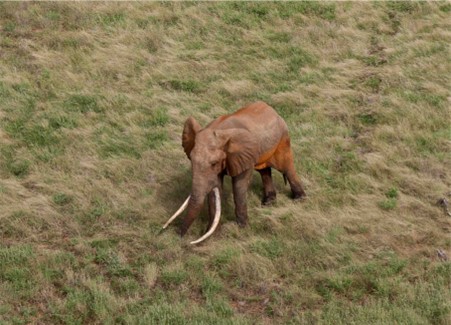
In Tsavo, field and aerial monitoring teams often observe elephants showing temporal gland stains, particularly among bulls in musth or when family groups reunite after separation. Understanding these patterns helps Tsavo Trust interpret behaviour, social cohesion, and stress levels across the elephant population. By studying physical cues like TGS alongside movement and population data, conservationists can build a clearer picture of elephant health and social stability in the Tsavo Conservation Area.
Why this matters for conservation
Recognising when and why elephants show TGS helps conservationists detect moments of disturbance or tension, guiding responses that protect both elephants and people. Protecting the integrity of elephant family structures and reducing stressors such as poaching, habitat loss, and human–elephant conflict supports healthier, more resilient populations.