

Across Europe, attitudes toward keeping elephants in captivity have changed. One of the clearest signs of this shift is the development of Europe’s first large-scale elephant sanctuary in Portugal, where former zoo and circus elephants will be relocated into far larger and more natural conditions.
The sanctuary, being developed in Portugal’s Alentejo region, is designed specifically for elephants whose physical and psychological needs could no longer be adequately met in traditional captive environments. Its first residents will include Julie, Portugal’s last circus elephant, and Kariba, a female African elephant transferred from a Belgian zoo where she had been living alone.
This project reflects a broader recognition among scientists, welfare organisations, and some zoos themselves: elephants are extraordinarily difficult animals to keep in captivity.
The challenge is not simply one of enclosure size. Elephants evolved for vast landscapes, highly dynamic social systems, constant movement, and complex decision-making. Many of these needs are fundamentally difficult to recreate in captivity.
Elephants evolved for movement
Wild African elephants can walk tens of kilometres each day as they move between feeding areas, water sources, shade, and social groups.
This movement is not incidental. It is central to elephant biology and ecology. In extreme conditions, elephants are capable of travelling extraordinary distances in search of resources. The longest recorded elephant movement in a single day was approximately 200 kilometres, demonstrating just how mobile these animals evolved to be.
Walking long distances helps maintain:
- joint and foot health
- muscle condition
- digestion
- mental stimulation
- social interaction
Even the largest zoo enclosures are tiny compared to the ranges elephants naturally occupy. The Portugal sanctuary is significant partly because of its scale. Although it will initially cover around 28 hectares, there are plans to expand it to roughly 405 hectares, making it far larger than conventional zoo facilities. (theguardian.com)
Yet even this remains small compared to the landscapes wild elephants routinely traverse.
Captivity fundamentally restricts one of the most important aspects of elephant life: free movement across large environments.
Elephants are highly social animals
Elephants possess some of the most complex social systems in the animal kingdom.
Female elephants live in tightly bonded matriarchal family groups composed of mothers, daughters, sisters, and calves. These relationships often persist for decades and are reinforced through communication, cooperation, and shared memory.
These societies are fluid and dynamic. Groups separate and reunite, relationships change over time, and social learning plays a major role in survival.
Captivity often disrupts these structures completely.
Many zoo elephants live in artificial social groupings that bear little resemblance to natural elephant societies. Some elephants are housed alone. According to the Guardian article, 36 elephants are currently living in solitary zoo conditions across Europe. (theguardian.com)
For a species that evolved around lifelong social interaction, this isolation can have serious welfare implications.
Captivity affects physical health
One of the clearest indicators that captivity struggles to meet elephant needs is reduced lifespan.
Research has shown that female African elephants in zoos live dramatically shorter lives than elephants in the wild. One study found that captive African females lived an average of approximately 17 years, compared to around 56 years in natural conditions when human-caused deaths were excluded. (theguardian.com)
Captive-born elephant calves also experience elevated mortality rates. Studies have found first-year mortality rates in captive Asian elephants approaching 30%, substantially higher than those observed in wild populations. (theguardian.com)
Physical health problems are common in captive elephants, particularly:
- foot disease
- arthritis
- chronic joint problems
- obesity
In the wild, elephants move continuously across varied natural terrain including soil, mud, sand, and vegetation. In captivity, they often spend prolonged periods on harder surfaces with significantly reduced movement.
Even with veterinary care and regular feeding, captivity frequently fails to replicate the environmental conditions elephants evolved under.
Psychological stress and stereotypic behaviour
Captivity affects elephants psychologically as well as physically.
Many captive elephants display stereotypic behaviours such as: repetitive swaying, pacing and head bobbing.
These repetitive movements are widely interpreted as indicators of compromised welfare and chronic stress.
Scientists believe such behaviours emerge from combinations of:
- restricted movement
- social disruption
- boredom
- lack of environmental stimulation
- inability to express natural behaviour
In the wild, elephants constantly make decisions about movement, feeding, social interaction, and risk. Their environments are highly varied and cognitively demanding.
Captive environments, even enriched ones, are comparatively static and controlled.
Elephants are cognitively complex animals
Elephants possess the largest brains of any land animal and demonstrate advanced cognitive abilities.
Research has documented:
- long-term memory
- social learning
- problem solving
- cooperation
- tool use
- self-awareness
This intelligence is closely connected to autonomy.
Wild elephants continually decide:
- where to move
- when to feed
- who to associate with
- how to respond to danger
Kate Moore, managing director of the Portugal sanctuary project, described “control over their lives” as essential for elephant welfare. (theguardian.com)
Captivity inevitably removes much of this independence. Feeding schedules, movement, social interactions, and daily routines are heavily controlled by humans.
For highly intelligent animals, this loss of autonomy may itself become a major welfare issue.
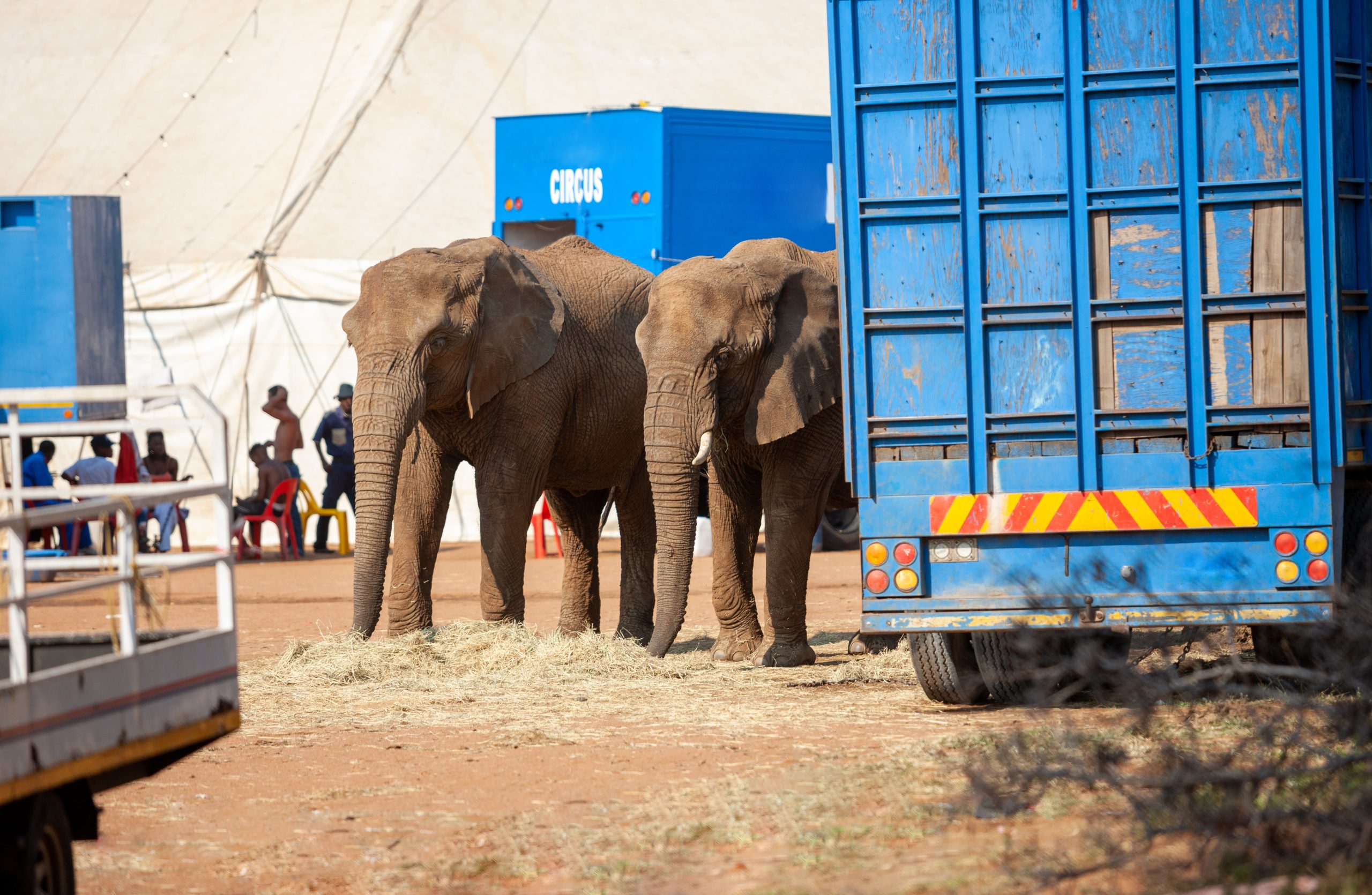
Circuses represent extreme captivity
Circuses historically represented one of the most restrictive forms of elephant captivity.
Elephants were transported frequently, confined for long periods, and trained to perform unnatural behaviours for entertainment.
Across Europe, public attitudes toward this practice have shifted rapidly. Portugal’s ban on wild animals in circuses came fully into effect in 2025, leading to Julie becoming the final circus elephant in the country to be relocated. (theguardian.com)
Many countries now recognise that the physical and psychological demands of circus life are fundamentally incompatible with elephant welfare.
The Kenya approach: rescue and rewilding
Not all elephants under human care remain in traditional captive conditions permanently.
In Kenya, orphaned elephant calves rescued through organisations such as the Sheldrick Wildlife Trust are raised with the long-term goal of rewilding rather than lifelong confinement.
Many of these calves arrive after losing their mothers to poaching, drought, human–wildlife conflict, or accidents. At a young age, elephant calves are entirely dependent on maternal care and would not survive alone in the wild.
Initially, keepers provide intensive support, including specialised milk formulas and around-the-clock care. However, the objective is always eventual reintegration into wild elephant society.
As the elephants mature, they are gradually introduced into freer conditions within the wider Tsavo ecosystem. They browse natural vegetation, interact with wild elephants, and progressively reduce their dependence on humans.
Many eventually reintegrate fully into wild populations while still occasionally returning voluntarily to rehabilitation areas. Some former orphans have later returned with calves of their own, demonstrating successful rewilding.
This differs fundamentally from traditional captivity. The emphasis is not on exhibition or permanent confinement, but on restoring natural behaviours, autonomy, and social integration wherever possible.
Why sanctuaries are different
Most captive elephants cannot simply be released directly into the wild. Many lack the experience, health, or social structures needed for survival.
Sanctuaries therefore aim to provide the closest possible approximation to natural elephant life.
The Portugal sanctuary is designed around:
- larger roaming areas
- natural substrates
- social opportunities
- reduced human interaction
- increased autonomy
Importantly, it will not function primarily as a public exhibition space. Welfare, rather than display, is the central goal. (theguardian.com)
Can elephants truly thrive in captivity?
Modern zoos often provide high-quality veterinary care, enrichment programmes, and support for conservation initiatives.
However, the fundamental challenge remains.
Elephants evolved for:
- vast landscapes
- constant movement
- highly dynamic social systems
- environmental complexity
- autonomy
These are extraordinarily difficult conditions to reproduce artificially.
The debate is therefore changing. The question is no longer simply whether elephants can survive in captivity, but whether captivity can ever fully meet the biological and psychological needs of such complex animals.
Final thoughts
The development of Europe’s first elephant sanctuary reflects a broader shift in how humans understand elephants.
Increasingly, elephants are being recognised not simply as animals that can be displayed, but as highly intelligent, socially sophisticated beings shaped by millions of years of evolution across enormous landscapes.
That growing understanding is leading many institutions toward an uncomfortable conclusion: captivity may never truly provide elephants with the lives they evolved to live.