

In Tsavo, it is common to see young elephants pushing against one another, trunks flailing, mock charges unfolding in bursts of energy. At first glance, it can appear chaotic or even unnecessary. But this behaviour is neither random nor trivial.
Play is one of the most widespread and important behaviours in the animal kingdom. Once overlooked in science, it is now recognised as central to development, behaviour, and even evolution itself.
What is play? A complex and misunderstood behaviour
Play is typically defined as voluntary, repeated behaviour that has no immediate survival function. It often appears exaggerated, inefficient, or out of context.
But play is not one single thing. It varies across species in form and complexity. Animals may engage in social play such as sparring or chasing, object play such as manipulating sticks or using their trunks, or locomotor play such as running and jumping.
Because of this diversity, no single theory fully explains play. It is a flexible, multi-layered behaviour shaped by both biology and environment.
Play exists across the animal kingdom
Play is not limited to intelligent mammals. While it is most visible in species like elephants and predators, research has shown that play behaviour exists across a wide range of life.
It has been observed in reptiles, fish, insects, and even cephalopods (squid, octopus). This suggests that play did not evolve once, but multiple times independently.
The implication is clear. Play is not a luxury. It is a recurring biological strategy.
Why animals play: function without a single purpose
Play does not always have a clear, direct benefit. Some forms may arise as byproducts of other traits, or persist simply because the costs are low.
However, in many cases, play provides both immediate and long-term advantages.
In the short term, play activates reward systems in the brain, driven by chemicals such as dopamine. It can reduce stress and reinforce behaviour.
Over the long term, play contributes to physical coordination, cognitive development, and social understanding. These benefits are not always measurable in simple terms, but they shape how animals respond to challenges later in life.
Importantly, play trains adaptability rather than specific skills.
The biology of play
There is no single “play centre” in the brain. Instead, play draws on broader systems involved in motivation, reward, and learning.
Different types of play activate different neural pathways. Social play, object play, and locomotor play all engage overlapping but distinct systems.
This reinforces the idea that play is not a specialised function, but an integrated part of how animals learn and interact with their environment.
Elephants: play as preparation for life
Among Africa’s wildlife, elephants offer one of the clearest examples of the importance of play.
Mock fighting and sparring
Young elephants, particularly males, frequently engage in pushing and sparring. These interactions test strength, balance, and coordination.
What appears playful is, in reality, preparation. As adults, male elephants will compete for dominance and mating opportunities. These early interactions allow them to learn limits, assess strength, and develop the physical and behavioural tools required later in life.
Learning to use the trunk
An elephant’s trunk is one of the most complex appendages in the animal kingdom, containing tens of thousands of muscles.
Calves are not born with control over it. They swing it, slap it, and struggle to use it effectively. Through repeated play and experimentation, they gradually develop the precision required for feeding, drinking, and communication.
Social learning and bonding
Play also builds social understanding. Chasing, mock charges, and group interactions allow elephants to read behaviour, establish relationships, and learn how to navigate their social world.
In a species with complex social structures, this flexibility is critical.
Play beyond youth
Play is not limited to calves. Sub-adult and even adult elephants continue to engage in playful behaviour, particularly males.
In these cases, play can reduce tension, reinforce bonds, and maintain social cohesion in a system where relationships are fluid and often competitive.
Predators: practising the hunt
In predators, play is closely tied to survival.
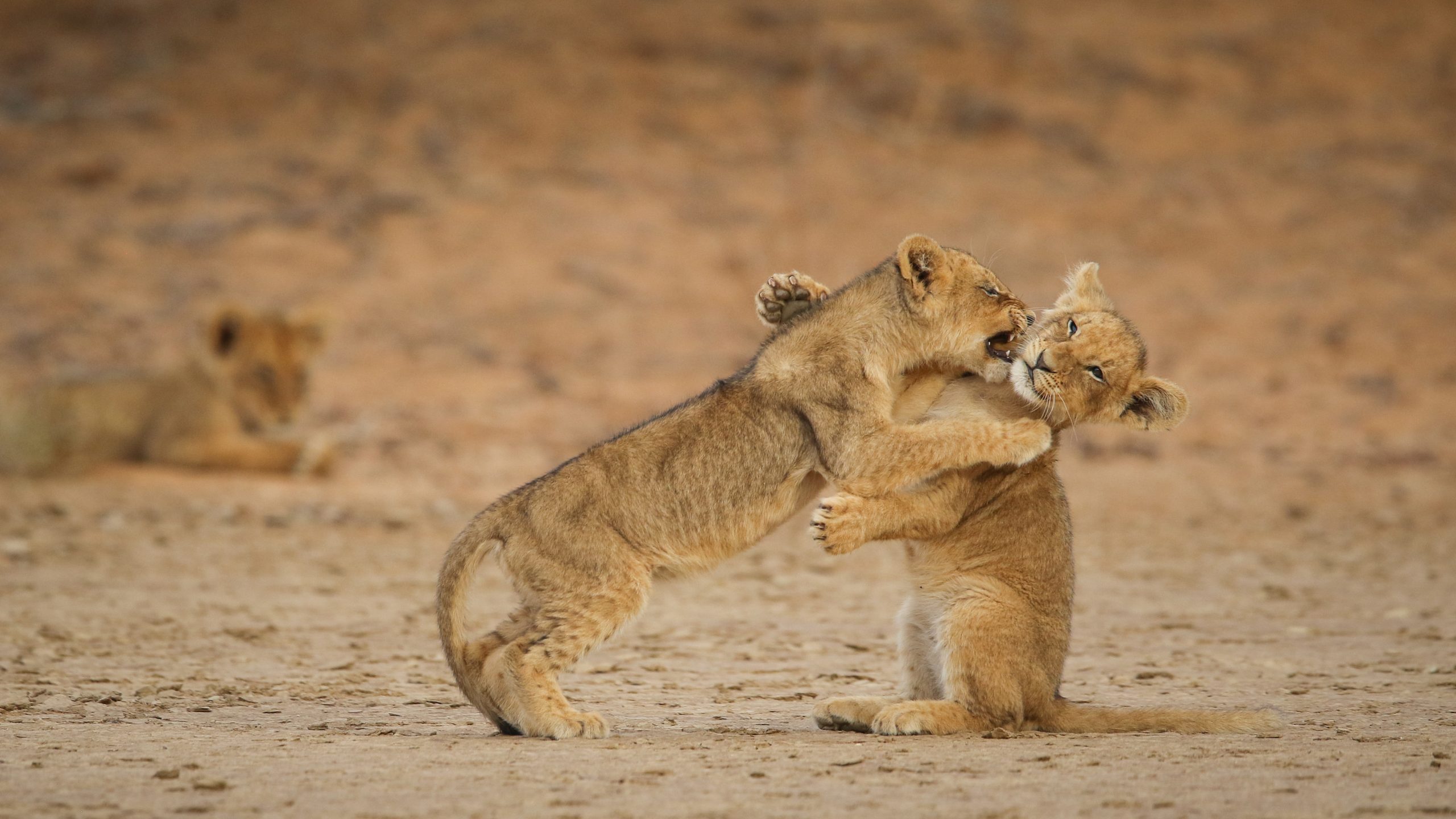
Young lions stalk, chase, and ambush their siblings. Cheetahs refine speed, timing, and coordination. Leopards develop stealth and control.
These behaviours mirror real hunting scenarios. The difference is that mistakes made during play carry little consequence. A failed pounce in play is a lesson. A failed hunt in the wild can mean starvation.
Play allows predators to build the skills they will rely on without the immediate risk.
The cost of play
Play is not without cost. It requires energy, time, and can expose animals to injury or predation.
Yet it persists because, in many cases, the long-term benefits outweigh these risks.
Not all play is directly useful. Some forms may not have a clear function at all. But where play contributes to coordination, social understanding, and adaptability, it provides a strong evolutionary advantage.
Why young animals play the most
Play is most common in young animals, where its impact on development is greatest.
It shapes brain development, particularly areas involved in decision-making and impulse control. It improves social competence and behavioural flexibility.
Species with longer childhoods, larger brains, and more complex social systems tend to show more elaborate forms of play. Elephants are a prime example.
Play reflects environment and society
The complexity of play is influenced by ecology and social structure.
Animals in stable environments with parental care have more time and energy to invest in play. Social species, where individuals must navigate complex relationships, rely more heavily on it.
In contrast, species under constant survival pressure may show less play behaviour.
What we see in Tsavo
In Tsavo, these principles are visible every day.
Young bulls spar in dry riverbeds. Calves experiment with their trunks at waterholes. Family groups engage in playful interactions that strengthen bonds and reinforce social structure.
These behaviours are not random. They are preparation for survival in a demanding and unpredictable environment.
Final thoughts: play as a foundation of survival
Play is often mistaken for something unnecessary. In reality, it is one of the foundations of life in the wild.
It shapes development, builds resilience, and allows animals to adapt to complex and changing environments.
Yet despite its importance, play remains only partially understood. It is not one behaviour with one purpose, but a flexible system that reflects deeper biological and social processes.
In the wild, play is where survival begins.