

Rhinos are among Africa’s most iconic species, yet they are also among the most endangered. Once abundant across the continent, they have been pushed to the edge of survival by poaching, habitat loss, and human expansion. Today, conservation efforts are making remarkable strides, but challenges remain.
At Tsavo Trust, protection of Tsavo’s black rhino population lies at the heart of our mission. Tsavo is home to one of Kenya’s most important strongholds for black rhinos, and our work supports both species-level recovery and the global fight to prevent extinction.
Black Rhinos – A fragile recovery
Africa’s black rhino (Diceros bicornis) population was once devastated, plummeting by 96% between 1970 and the 1990s. Today, numbers are slowly increasing, with just under 7,000 black rhinos surviving across the continent.
Kenya is a leader in black rhino conservation, holding nearly 1,000 individuals, most belonging to the eastern black rhino subspecies (D. b. michaeli). Tsavo West National Park is a cornerstone of this recovery, with its Intensive Protection Zone (IPZ) offering a secure sanctuary. This IPZ alone has the potential to hold up to 500 black rhinos, making it a critical site for future population growth.
Thanks to sustained monitoring, aerial patrols, and close collaboration with the Kenya Wildlife Service (KWS), Tsavo Trust helps protect these rhinos from poaching and supports their gradual recovery.
Southern White Rhinos – From the brink to rebound
The southern white rhino (Ceratotherium simum simum) offers one of conservation’s greatest comeback stories. Once reduced to fewer than 50 animals in South Africa’s Hluhluwe-iMfolozi Park in the late 1800s, careful protection and translocations have seen their numbers rebound to about 15,700 individuals today.
Kenya is home to around 840 southern white rhinos, with strong populations in Ol Pejeta Conservancy and Nairobi National Park. Translocations remain a key part of their survival strategy, helping to spread risk, diversify genetics, and re-establish populations across former ranges.
The Northern White Rhino – A race against time
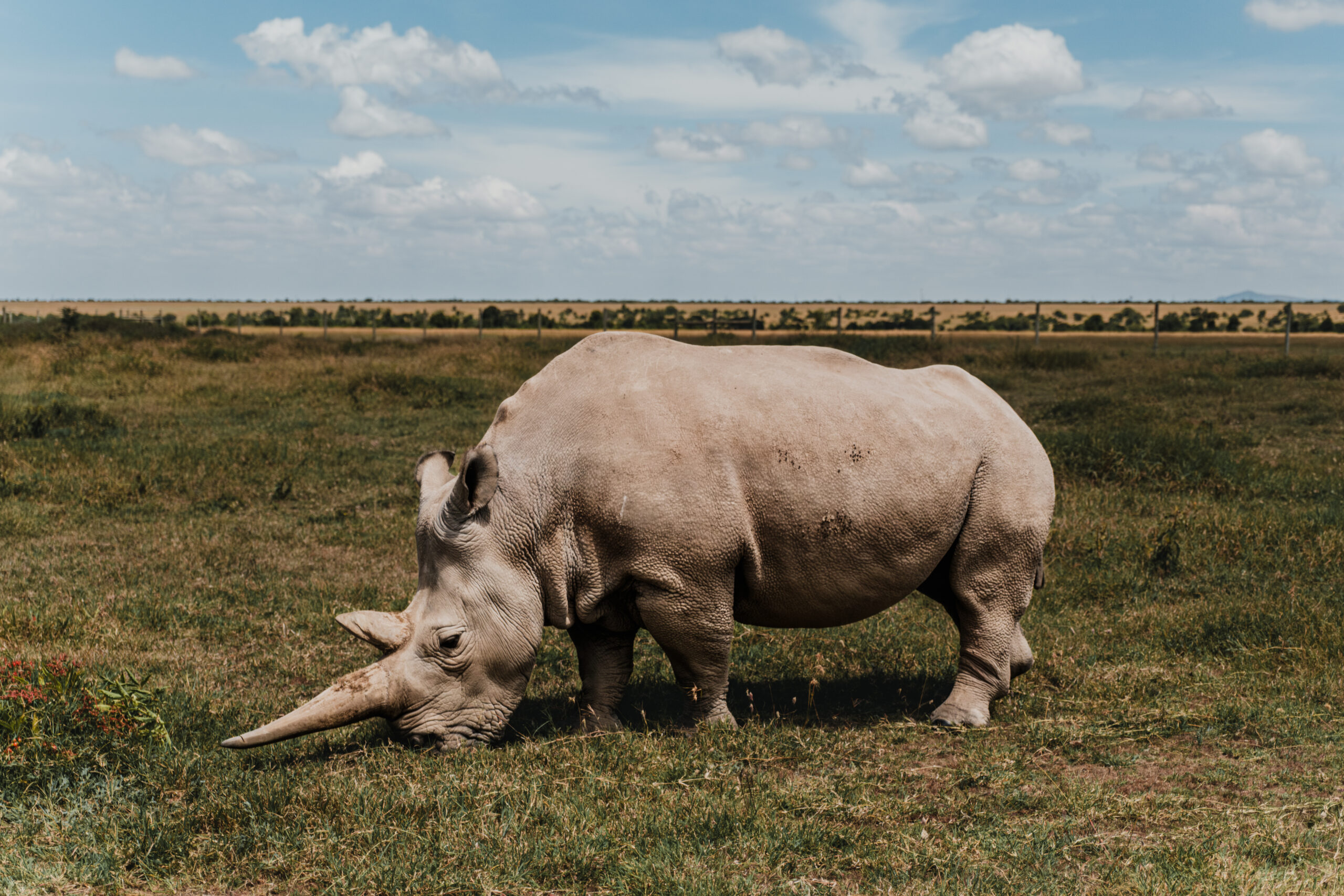
The northern white rhino (Ceratotherium simum cottoni) represents one of the most dramatic conservation crises of our time. Once ranging across parts of Central and East Africa, the subspecies is now functionally extinct. Only two individuals remain—Najin and her daughter Fatu—both females living under 24-hour armed protection at Ol Pejeta Conservancy in Kenya. With no surviving males and neither female able to carry a pregnancy, the species’ survival now rests entirely in the hands of science.
Yet hope remains. The BioRescue project, a global scientific collaboration led by the Leibniz Institute for Zoo and Wildlife Research (Leibniz-IZW) in Germany and coordinated by Safari Park Dvůr Králové in Czechia, has made groundbreaking progress over the past six years. Working closely with Kenya Wildlife Service (KWS) and the Wildlife Research and Training Institute (WRTI), the team continues to push the boundaries of reproductive technology.
Since the first oocyte (egg) collection from Fatu and Najin in 2019, scientists have conducted 21 such procedures—three of them in 2025 alone. These have yielded a total of 38 pure northern white rhino embryos, created using Fatu’s eggs and preserved sperm from long-deceased northern white rhino males. The embryos are stored safely at the Avantea laboratory in Italy, awaiting successful transfer into surrogate southern white rhino females.
Progress, while slow, is real. At the end of 2023, BioRescue achieved a world first—a successful pregnancy in a southern white rhino following in-vitro fertilisation (IVF). This was a vital proof of concept showing that embryo transfer in rhinos is possible. Since then, three separate transfers using northern white rhino embryos—in July 2024, December 2024, and May 2025—have been attempted. None have yet resulted in a lasting pregnancy, though mucus development in the uterus of a surrogate female after the December 2024 transfer suggests that partial implantation occurred.
These subtle signs give researchers cautious optimism. Each failed attempt brings vital information about timing, hormone cycles, and uterine conditions—knowledge that improves the likelihood of future success. Meanwhile, the complete sequencing of the northern white rhino genome now opens doors to new technologies, such as generating sperm and egg cells from stem cells.
Although time is short, the dedication of conservationists and scientists shows that extinction is not yet inevitable. Each embryo represents not just genetic potential, but hope—hope that one day, the northern white rhino may once again walk the grasslands of Africa.
Translocations – Spreading the risk
Moving rhinos into new, carefully chosen habitats has become a cornerstone of conservation. This approach ensures that no single population carries all the risk of disease, poaching, or drought.
In Kenya, both black and white rhinos have been translocated into sanctuaries and IPZs.
Tsavo West’s Intensive Protection Zone is part of this national strategy, providing a vast, semi-arid refuge for black rhinos.
Across Africa, reintroductions have restored rhinos to countries where they had been wiped out, such as Uganda and Rwanda.
Threats that remain
Despite progress, rhinos face immense challenges:
Poaching: Driven by the black-market value of rhino horn, which remains highly prized in parts of Asia.
Habitat loss: Expanding farms and settlements shrink rhino ranges.
Climate stress: Droughts place pressure on water and forage.
Genetic bottlenecks: Particularly acute in the case of the northern white rhino.
Hope for the Future
The trajectory of rhino conservation shows both warning and promise. Southern white rhinos demonstrate what is possible when protection and community support align. Black rhinos, while still vulnerable, are slowly climbing back. And even the northern white rhino, once thought doomed, may yet survive through cutting-edge science.
In Tsavo, rhino conservation is a living story. Our aerial patrols, ground teams, and community partnerships safeguard one of Kenya’s largest rhino landscapes. The red soils of Tsavo still carry the footprints of these ancient animals—and with continued protection, they will for generations to come.
Call to Action
The survival of Africa’s rhinos depends on more than fences and rangers. It requires long-term commitment, international collaboration, and community support. At Tsavo Trust, we invite you to be part of this mission. By supporting our work, you help keep rhinos safe, expand their habitats, and give even the rarest of species—like the northern white rhino—a chance at a future.