

In dry African ecosystems, access to water can determine where animals move, feed and survive. During severe droughts, when seasonal rivers and pans disappear, permanent water sources can become particularly important for wildlife.
Providing additional water can therefore appear to be a relatively straightforward conservation intervention. A borehole, dam or pumped waterhole increases the amount of water available to animals when natural sources are scarce.
Ecologically, however, the consequences are considerably more complex.
Research from African savannas has shown that artificial water sources can alter the distribution of herbivores, increase pressure on vegetation and influence where predators encounter their prey. Recent research on African wild dogs has added another dimension: water distribution may even affect how competing carnivores avoid one another.
The important question is therefore not simply whether artificial waterholes help wildlife. It is how changing the distribution and permanence of water changes the wider ecosystem around them.
Water is part of the structure of a dry ecosystem
Seasonal water scarcity is a natural feature of semi-arid African savannas.
As temporary water sources disappear during the dry season, water-dependent animals become increasingly restricted to areas around rivers, pools and other remaining sources. Other species are less dependent on drinking water and can continue using areas further from permanent water.
Rainfall eventually changes this distribution again. Temporary pans fill, vegetation responds and wildlife can disperse across a much greater proportion of the landscape.
This variation in water availability creates spatial and seasonal differences in grazing, browsing, predation and animal movement.
Permanent artificial water changes this pattern.
Rather than allowing an area to become progressively drier as the dry season advances, a borehole or pumped waterhole can maintain a reliable resource throughout the year. Animals that would otherwise have moved elsewhere may therefore continue using the surrounding habitat.
Research from several African ecosystems shows that the ecological effects can extend well beyond the waterhole itself.
Artificial water can change where herbivores live
One of the clearest examples comes from South Africa’s Kruger National Park.
From the 1930s onwards, Kruger underwent an extensive programme of artificial water provision. More than 300 boreholes were drilled, around 50 earth dams were constructed and seasonal and perennial rivers were modified. The objective was partly to make previously water-limited areas available to wildlife throughout the year.
The intervention worked in one important respect: it changed how animals used the landscape.
A later study analysed seven years of dry-season aerial census data for 13 large herbivore species. Researchers found that artificial waterholes acted as important centres of animal activity and influenced herbivore distribution at the landscape scale.
Most grazing species were associated with artificial waterholes. Browsers and mixed feeders responded differently and were more strongly associated with major rivers. The strength of these relationships also depended on the underlying geology and associated forage conditions.
The significance is important.
Adding a waterhole does not affect every species equally. It can favour animals that need to drink regularly while having much less influence on species capable of ranging further from surface water.
Artificial water can therefore change the relative distribution of species across a landscape, rather than simply increasing water availability for wildlife as a whole.
What happens to the vegetation?
When animals repeatedly concentrate around water, their effects on vegetation can become concentrated as well.
Ecologists sometimes describe the resulting pattern as a piosphere, where grazing, browsing and trampling are most intense close to water and generally decline with distance.
Elephants can produce particularly substantial effects because of their size, abundance and ability to modify woody vegetation.
Research in Zimbabwe’s Zambezi National Park examined vegetation surrounding pumped waterholes in an area supporting high elephant densities. The researchers documented the relationship between proximity to permanent water and elephant impacts on woody vegetation, adding to evidence that water distribution can influence where browsing pressure becomes concentrated.
More recent research from Botswana provides another example.
A 2024 study examined landscape changes around an artificial water point established in the Chobe Enclave. Using satellite observations covering 2002 to 2022, researchers compared vegetation before and after the water point was introduced.
They detected significant declines in woodland across distance bands extending from the immediate surroundings of the water point out to 10 kilometres. The authors concluded that continuous and poorly planned artificial water provision can contribute to substantial ecological changes in savanna landscapes.
The relationship between water and vegetation is therefore not limited to the immediate edge of a waterhole.
By changing where large herbivores spend their time, permanent water can influence how vegetation is used across a much larger area.

Elephants change their movements when water changes
Elephants provide a particularly useful demonstration of this relationship.
Elephants visited rivers more frequently than artificial waterholes overall. However, artificial waterholes allowed them to use areas further from rivers at a lower movement cost. Across approximately one-third of the total area traversed by the monitored elephants, animals used artificial waterholes instead of rivers.
The researchers concluded that artificial water provision altered elephant spatial-use patterns and could increase the intensity with which some areas were used.
This has wider ecological implications because elephants are major ecosystem engineers.
Changing where elephants spend time can change where trees are browsed or pushed over, where seeds are dispersed and where pathways are created through vegetation. Water management can therefore indirectly influence habitat structure through its effects on elephant movement.

Waterholes can also change predation
Herbivores are not the only animals responding to water.
Where prey concentrates, predators can respond.
Research from Hwange National Park in Zimbabwe has shown that lion predation can become concentrated around waterholes. At Ngamo Pan, researchers found strong selection by lions for kill sites within two kilometres of water for most prey categories examined.
This does not mean that waterholes automatically create unusually high predation everywhere. Vegetation structure, prey species, season, predator density and the distribution of alternative water sources all influence the outcome.
It does demonstrate an important ecological mechanism.
Changing the distribution of water can change the distribution of prey, which can in turn change opportunities for predators.
Recent research from Hwange suggests that the consequences extend even further.
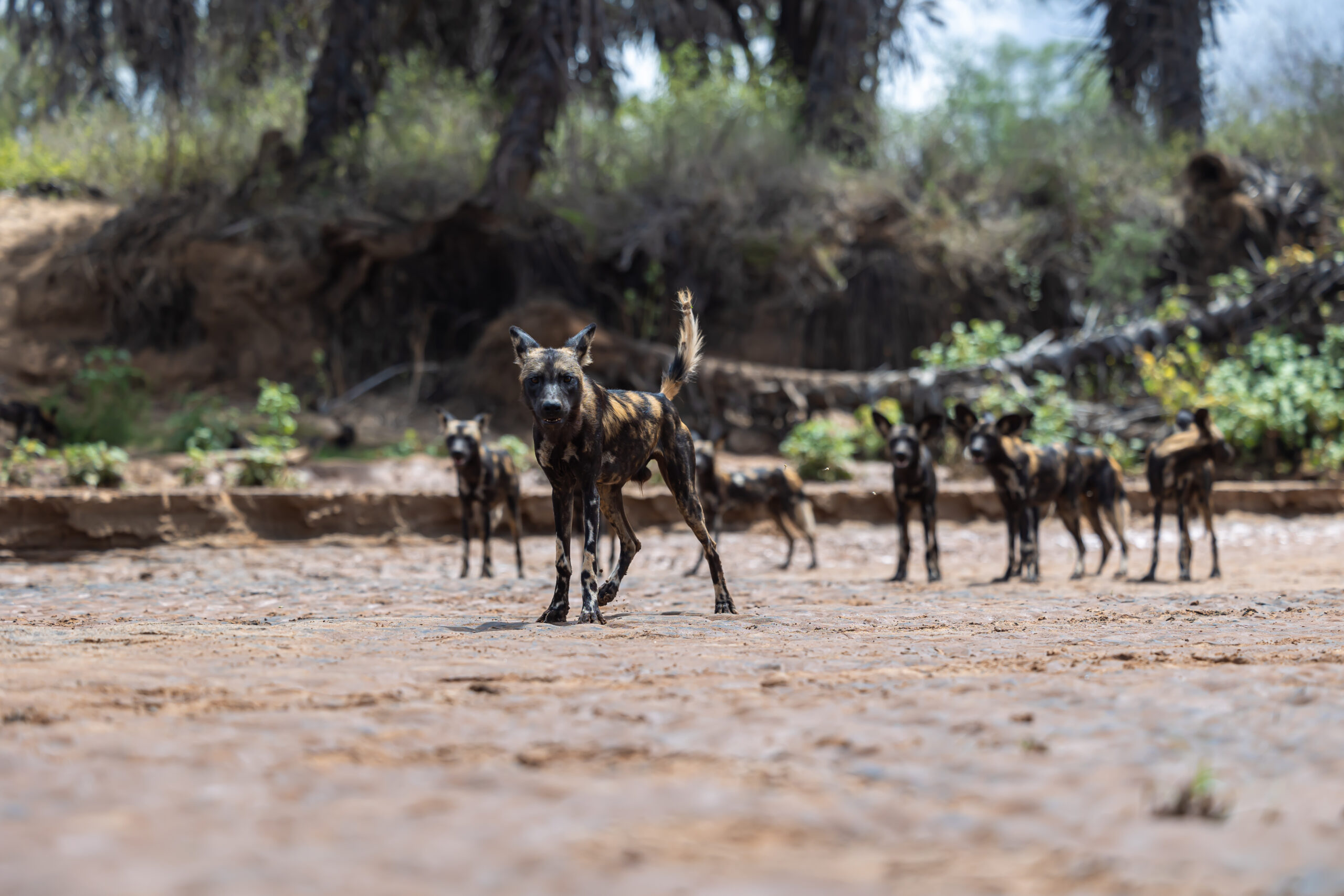
What happens to African wild dogs?
African wild dogs occupy an unusual position within Africa’s large-carnivore community.
They are highly effective predators, but they are subordinate to larger carnivores. Lions can kill wild dogs, while spotted hyenas compete with them for food and can steal their kills.
Wild dogs therefore need access to sufficient prey while simultaneously managing the risks created by other predators.
The researchers found that wild dogs did not simply avoid all areas used by larger predators.
Instead, different carnivores could use the same parts of the landscape while separating their activity in time.
Crucially, this temporal avoidance became stronger close to waterholes.
Wild dogs showed evidence of proactively avoiding lions and probably leopards, while their relationship with spotted hyenas involved both proactive and reactive avoidance.
Waterholes were therefore not simply places where animals drank. They formed part of the landscape around which interactions between competing predators were structured.
The relationship is not as simple as more water meaning more competition
The Hwange research produced an important result that prevents a simple conclusion that artificial water is harmful to wild dogs.
The researchers found that wild dogs could coexist with dominant carnivores in prey-rich areas where sufficient permanent water was available, provided other ecological conditions were suitable. They ultimately recommended maintaining heterogeneity in water provision, rather than simply maximising or eliminating artificial water sources.
A related 2024 study investigated competition for prey between wild dogs, lions, spotted hyenas, leopards and cheetahs across areas of Hwange with different densities of waterholes.
Wild dogs showed substantial dietary overlap with the other predators, particularly lions and hyenas. Interestingly, dietary overlap between lions and wild dogs was highest in the area with the lowest waterhole density.
This reveals an ecological trade-off.
Where permanent water is scarce, prey availability and distribution may increase competition over food.
Where permanent water is abundant, prey can become concentrated or redistributed in ways that increase encounters between competing predators.
Neither extreme necessarily produces the best conditions for every species.
The ecological consequences depend on the density, distribution and permanence of water across the landscape.
Why Kruger changed its approach
Kruger’s experience provides an important long-term case study of how thinking about artificial water has evolved.
For decades, management sought to increase and stabilise water availability. Eventually, however, concerns developed that the dense network of permanent waterholes was reducing natural ecological variability and favouring common water-dependent herbivores.
During the 1990s, more than half of Kruger’s artificial waterholes were closed.
The change reflected a broader shift in conservation management.
Rather than attempting to keep environmental conditions relatively constant, managers increasingly recognised that variability itself can be an important ecological process.
Importantly, the results of closing waterholes were not universally positive either. Some rare antelope populations continued to decline after closures, illustrating again that water management does not produce simple or uniform ecological outcomes.
The lesson from Kruger is therefore not that providing water was wrong.
It is that changing something as fundamental as water availability can produce ecological effects that may only become apparent over decades.
What does this mean for Tsavo?
The question is particularly relevant to the Tsavo Conservation Area.
Tsavo is a predominantly dry landscape where rainfall is highly seasonal and much of the surface water available to wildlife varies considerably throughout the year. The ecosystem contains major natural water sources, including the Tsavo and Athi-Galana river systems, alongside seasonal rivers, pans and artificially maintained water sources.
Water management is therefore already an important conservation issue within the ecosystem. Kenya has previously commissioned work specifically examining wildlife water requirements in Tsavo East and Tsavo West, reflecting the complexity of balancing water scarcity, wildlife movement and human-wildlife conflict.
The subject also has a long research history in Tsavo. A University of Nairobi study published in 1974 documented greater wildlife visitation to artificial waterholes during the dry season and found that animals aggregated around waterholes that retained drinking water.
Tsavo Trust has itself approached water provision through sand dams, which retain water within sand in seasonal river systems rather than creating conventional continuously pumped surface-water points. Between 2019 and 2023, Tsavo Trust constructed 13 sand dams for wildlife in Tsavo East and Tsavo West in partnership with other stakeholders.
This approach is significant because the scientific evidence increasingly suggests that the method, location and permanence of water provision matter.
Could sand dams have different ecological effects?
Unlike conventional pumped waterholes, sand dams store water within the sand of seasonal riverbeds rather than maintaining permanent exposed surface water. Wildlife can access this stored water during dry periods, with elephants particularly capable of digging through sand to reach water below the surface.
This difference could be ecologically important. Research from Tanzania’s Ruaha National Park found that wildlife used waterholes within sandy riverbeds, including those excavated by elephants. Because these water sources could shift between years, researchers suggested that the concentrated vegetation impacts associated with repeatedly attracting animals to the same fixed water point may be reduced.
However, there is currently little research directly comparing the ecological effects of sand dams with conventional permanent waterholes. It therefore remains an important research question whether sand dams can improve dry-season water availability while retaining more of the natural seasonality and spatial variability of water in arid ecosystems.
For Tsavo, long-term monitoring could help answer this question by examining wildlife use, vegetation change and animal movements around sand dams over time. This would help establish not simply whether additional water benefits wildlife, but how different methods of providing that water influence the wider ecosystem.

Artificial water is a conservation intervention
The evidence from Hwange, Kruger, Chobe and other African savannas does not support a simple conclusion that artificial waterholes are either beneficial or harmful.
During severe drought, additional water can provide an important resource for wildlife. In fragmented landscapes, strategically located water may also influence whether animals remain within protected areas or move into areas where the risk of human-wildlife conflict is greater.
But permanent water can also alter herbivore distribution, elephant movement, vegetation pressure, predator-prey relationships and competition between carnivores.
Providing water is therefore not ecologically neutral.
Like fire management, fencing or wildlife translocation, it is an intervention capable of changing the system in which it is introduced.
The emerging scientific evidence instead supports strategic and heterogeneous water management, informed by the characteristics of individual ecosystems and monitored over long periods.
For Tsavo, this means understanding not only whether wildlife has enough water, but how the location and persistence of that water influences animal movement, vegetation and interactions between species.
As climate variability and human pressures increasingly affect dry African ecosystems, these questions will become more important.