

From lions capable of bringing down prey several times their own weight to small wildcats hunting rodents through the scrub, the Tsavo Conservation Area supports a remarkable diversity of felines.
At least six wild cat species occur within the wider Tsavo ecosystem: lion, leopard, cheetah, serval, caracal and African wildcat. They all belong to the family Felidae and share the fundamental characteristics of highly specialised mammalian predators, yet they make their living in very different ways. Tsavo Trust has previously documented all six within the ecosystem, including both normally coloured and melanistic servals.
Body size is only part of the difference. Tsavo’s cats hunt different prey, favour different habitats and use different hunting strategies. These differences help reduce direct competition and allow multiple feline predators to coexist across the same enormous landscape.
Lion: Tsavo’s largest cat
The African lion (Panthera leo) is by far Tsavo’s largest feline and occupies a very different ecological position from the smaller cats with which it shares the landscape.
Lions are powerful ambush predators capable of hunting large ungulates. Unlike most cats, they are also highly social. Pride living allows individuals to cooperate in territorial defence, cub rearing and, in some circumstances, hunting. However, group size and social structure vary considerably between ecosystems.
Tsavo’s semi-arid environment creates very different conditions from the productive grasslands more commonly associated with East African lions. Prey, vegetation and water are distributed unevenly across an enormous landscape, and understanding how lions respond to this variability remains an active area of research.
The scale of Tsavo makes counting them difficult. A major spoor survey conducted across Tsavo East and Tsavo West in 2013 estimated 706 ± 201 lions, equivalent to an estimated density of 3.39 lions per 100 km². At the time, the study concluded that Tsavo supported Kenya’s largest remaining lion population and was one of East Africa’s major lion strongholds. These figures should be treated as a historical population estimate rather than a current count.
Research into Tsavo’s lions is continuing. The Tsavo Simba Research Project now combines GPS and satellite collars, individual identification, camera traps and direct observations to investigate movement, predation and social behaviour in the ecosystem.
Tsavo’s male lions are also famous for their relatively small or sometimes almost absent manes. Although this characteristic has generated considerable interest, mane development in lions is influenced by several factors, and the ecology of Tsavo’s lions extends far beyond their appearance.

Leopard: the adaptable ambush hunter
The leopard (Panthera pardus) shares the genus Panthera with the lion but follows a very different strategy.
Leopards are primarily solitary hunters. Rather than relying on cooperative hunting or prolonged pursuit, they use vegetation and terrain to approach prey before attacking over a short distance.
This makes cover particularly valuable.
The 2013 Tsavo survey found that leopard occupancy was higher in parts of northern Tsavo West and north-western Tsavo East characterised by denser vegetation. Across the two national parks, the study estimated approximately 472 ± 98 leopards, at a density of around 2.27 animals per 100 km². Again, this is a baseline derived from the 2013 survey rather than an estimate of how many leopards live in Tsavo today.
Leopards also have an exceptionally broad diet. Depending on availability, they can hunt animals ranging from relatively small mammals and birds to sizeable antelope.
Their ability to exploit different prey and habitats is one reason leopards occur across such a wide range of African environments. But adaptability does not make them immune to habitat loss, declining prey populations or conflict with people.

Cheetah: built for pursuit
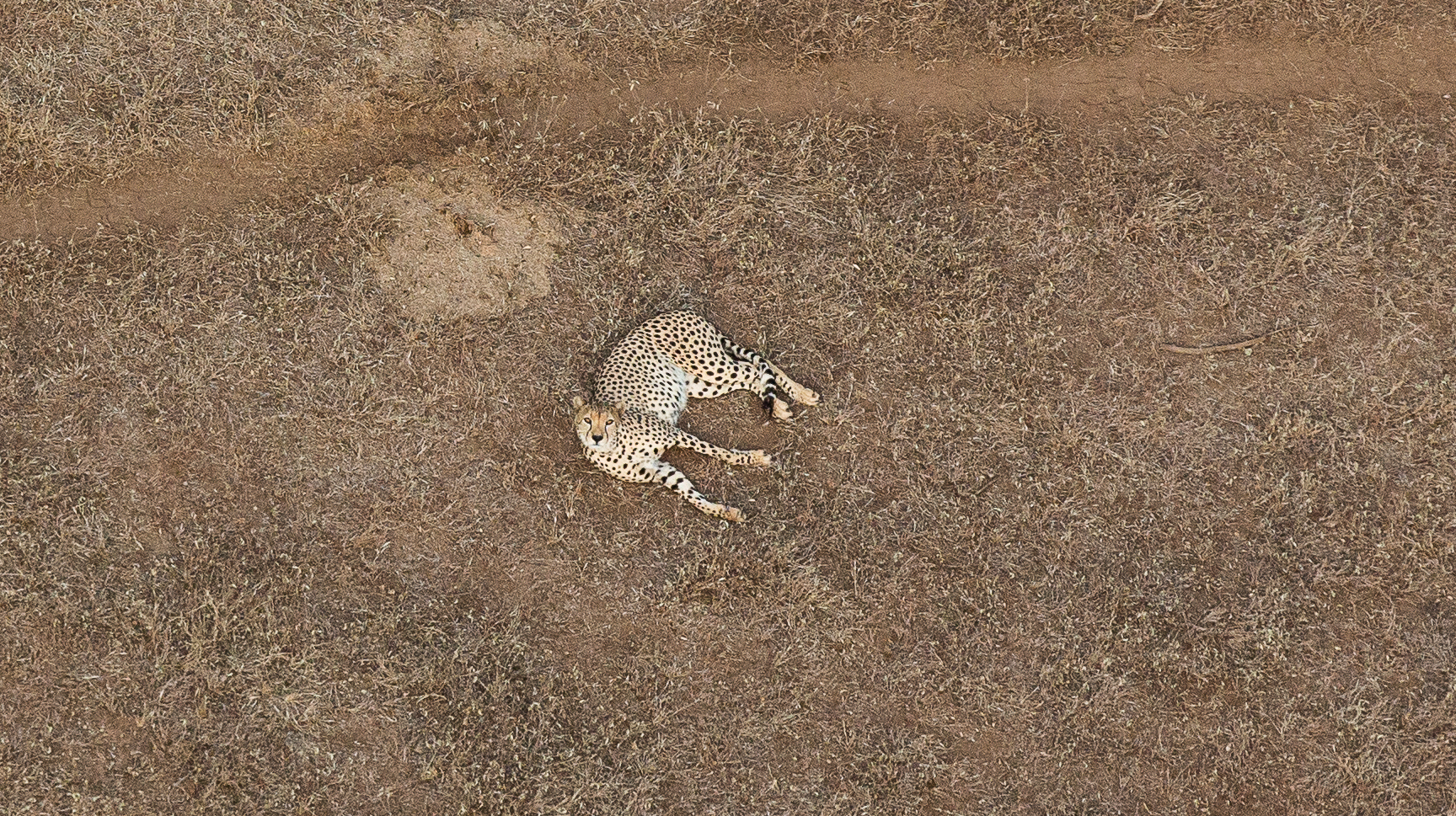
The cheetah (Acinonyx jubatus) has taken feline evolution in a very different direction.
Where a leopard depends heavily on concealment and explosive ambush, the cheetah is specialised for pursuit. Long limbs, a lightweight body, flexible spine and relatively non-retractile claws contribute to its extraordinary acceleration and speed.
This hunting strategy favours relatively open habitat where prey can be detected and pursued.
But specialising for speed comes with trade-offs. Cheetahs are considerably less powerful than lions and generally cannot defend themselves or their kills against larger competitors. Lions and spotted hyenas can steal cheetah kills, while lions can also kill cheetahs.
Cheetahs must therefore find prey while simultaneously navigating a landscape occupied by more dominant carnivores.
They also occur at naturally low densities. The 2013 Tsavo survey estimated approximately 154 ± 74 cheetahs, or about 0.74 per 100 km². Their distribution was considerably more patchy than that of lions.
Low density, however, does not mean low conservation importance. Tsavo’s enormous size and its connections with surrounding wildlife landscapes make it an important area for a species requiring extensive space.
The Tsavo Cheetah Project uses photographs, spoor, direct sightings and camera traps to identify individuals and investigate movements between the protected area and surrounding community land. This is particularly important because cheetahs moving beyond protected areas can encounter livestock and consequently face the risk of retaliatory killing.
Serval: hunting what it can hear
The serval (Leptailurus serval) occupies an entirely different predatory niche.
Its disproportionately long legs and enormous ears are adaptations for hunting small animals in relatively dense vegetation. Rodents form an important component of its diet, alongside birds and other small vertebrates.
Rather than chasing prey across open ground like a cheetah, servals can use sound to detect animals concealed in vegetation before launching a characteristic high pounce onto their prey.
Habitat requirements consequently differ from those of Tsavo’s larger cats. Servals are particularly associated with grasslands and wetter habitats, making their distribution within a dry ecosystem such as Tsavo uneven.
Tsavo is also notable for records of melanistic servals. Melanism results from increased dark pigmentation, producing animals whose coats can appear almost entirely black, although their underlying spotting may remain visible. Both melanistic and normally coloured servals have been documented within the Tsavo Conservation Area.
Unlike lions, leopards and cheetahs, there is no comparable landscape-wide published population estimate for Tsavo’s servals. This illustrates a wider problem in carnivore research: smaller and more elusive species often receive considerably less population-level monitoring than their larger relatives.

Caracal: a predator of the dry country
The caracal (Caracal caracal) is another medium-sized feline found within Tsavo, but its ecology differs considerably from that of the serval.
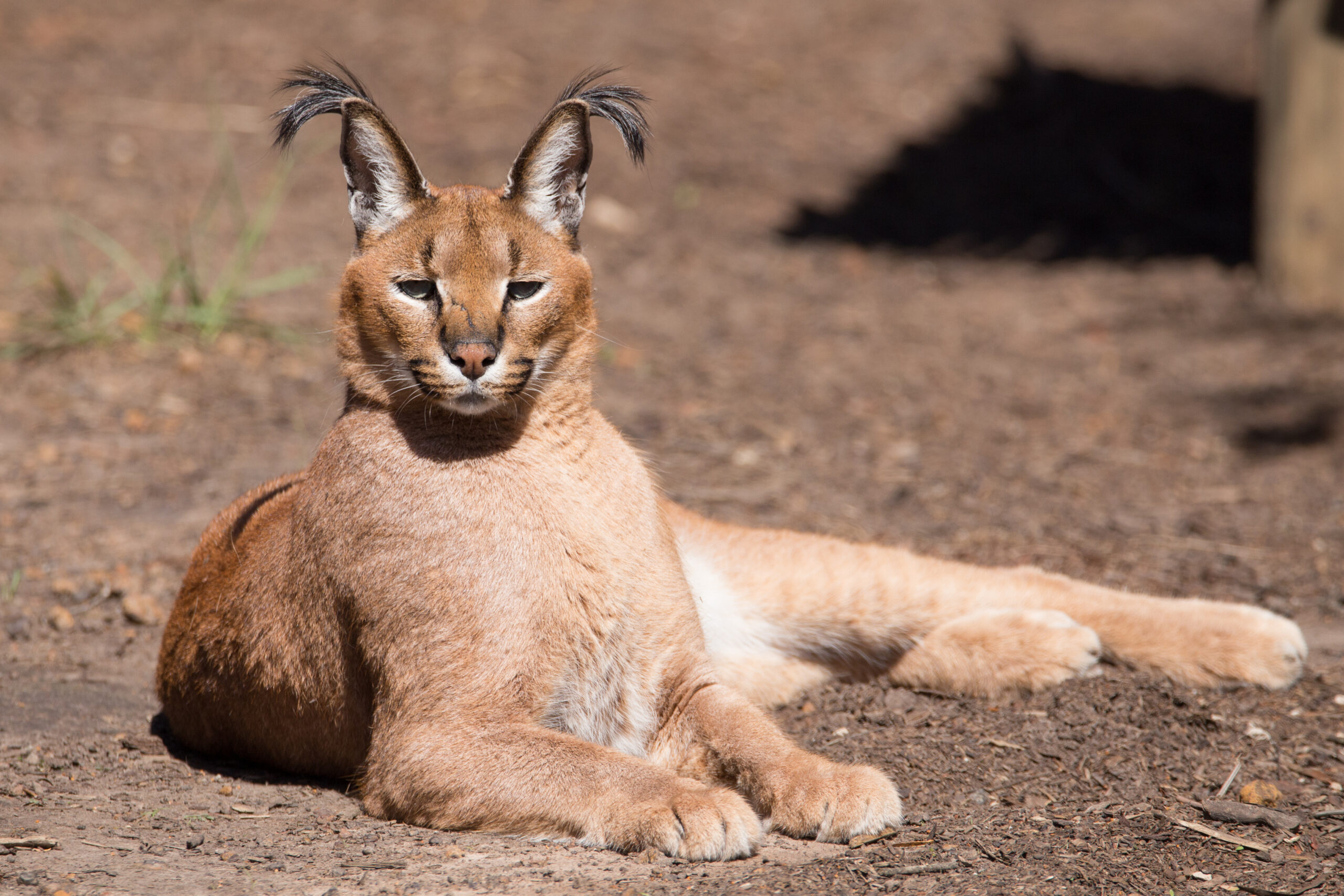
Caracals are compact, muscular cats recognisable by their reddish coats and distinctive black ear tufts. They are well adapted to dry savanna, scrub and semi-arid environments.
They hunt primarily by stalking and rapidly attacking at close range. Their diet can include rodents, hares, birds and small antelope, and they are capable of taking surprisingly large prey relative to their own body size.
Their famous ability to leap into the air to catch birds is an extension of this explosive hunting strategy rather than their principal ecological role.
Again, there is no robust published estimate for the number of caracals in Tsavo. Their elusive behaviour, low visibility and relatively limited research attention make them difficult to count.
African wildcat: Tsavo’s s
mallest feline
At the other end of the scale from the lion is the African wildcat (Felis lybica).
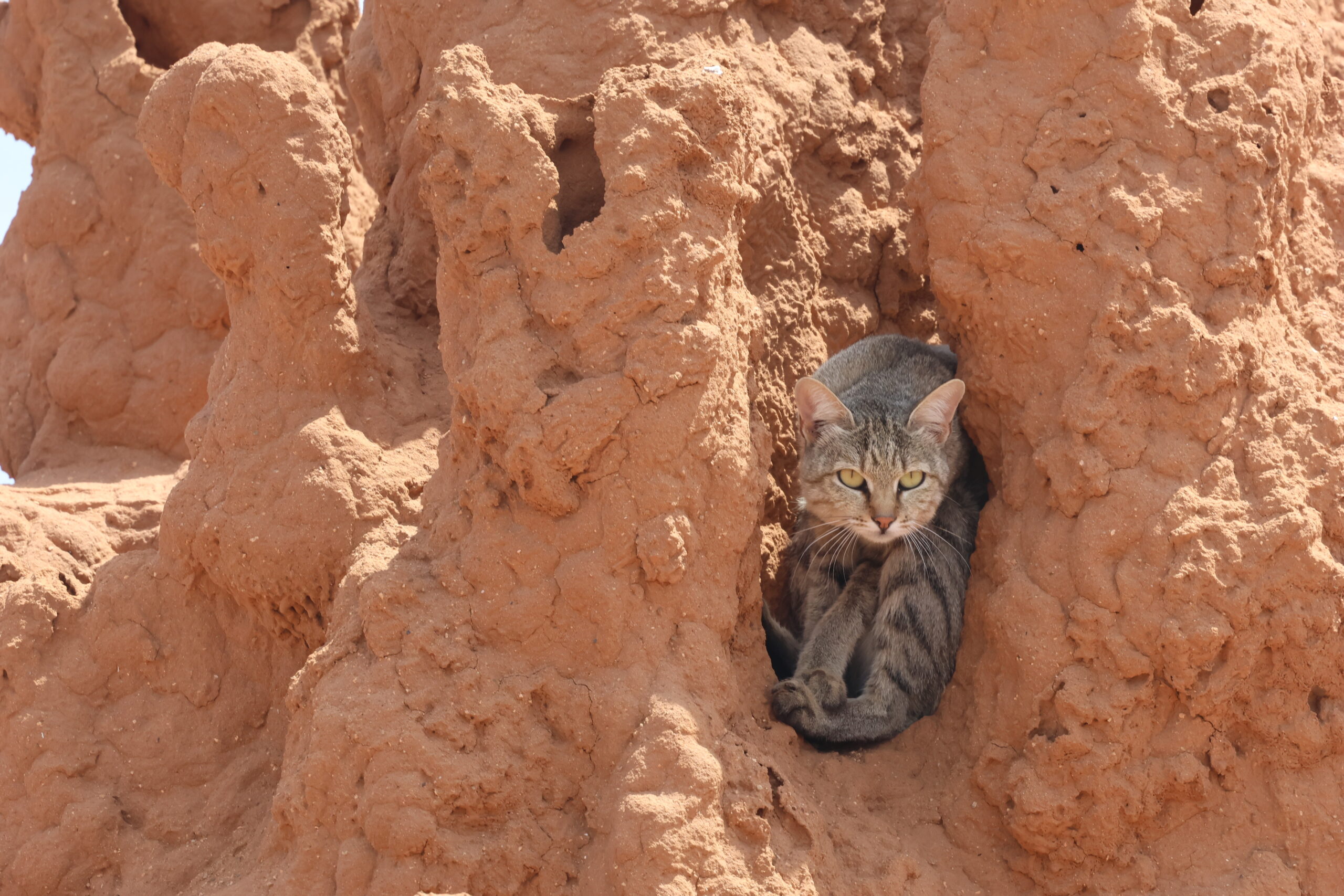
At first glance, an African wildcat can look remarkably similar to a domestic tabby. This resemblance is not coincidental. African wildcats are the wild ancestors from which domestic cats originated.
In Tsavo, their ecological world is completely different from that of the large cats. They predominantly hunt small prey such as rodents, birds, reptiles and insects, allowing them to occupy the same wider landscape without directly competing with lions or cheetahs for food.
Their similarity to domestic cats also creates a conservation problem. African wildcats can interbreed with free-ranging domestic cats, potentially reducing the genetic distinctiveness of wild populations. Tsavo Trust has previously highlighted hybridisation as one of the conservation concerns facing the species.
As with servals and caracals, we do not currently have a reliable population estimate for African wildcats across Tsavo.
Six cats, six different strategies
Looking at Tsavo’s cats together demonstrates how evolution has produced remarkably different predators from the same basic feline body plan.
| Species | Approximate adult weight | Principal hunting strategy | Typical prey |
|---|---|---|---|
| Lion | 100–220+ kg | Stalking and ambush, sometimes cooperative | Medium to large ungulates |
| Leopard | 25–90 kg | Solitary stalking and ambush | Small to medium mammals and ungulates |
| Cheetah | 35–65 kg | High-speed pursuit | Small to medium ungulates |
| Caracal | 7–20 kg | Stalking and explosive pounce | Rodents, birds, hares, small antelope |
| Serval | 7–18 kg | Detection and high pounce | Rodents and other small vertebrates |
| African wildcat | 3–6 kg | Stalking and pouncing | Rodents, birds and reptiles |
These differences are central to understanding how so many predators can coexist.
How do six feline predators share one landscape?
Ecologists describe the division of resources between species as niche partitioning.
Prey size provides one obvious division. A lion capable of killing a buffalo occupies a fundamentally different feeding niche from an African wildcat hunting a mouse. But body size alone does not explain coexistence.
Habitat provides another division. Leopards can exploit dense vegetation that provides concealment. Cheetahs benefit from more open areas where prey can be detected and pursued. Servals are particularly adapted to hunting small prey in grass and wetter habitats, while caracals are well suited to dry scrub and savanna.
Hunting strategies divide resources further. Cheetahs pursue prey at speed, leopards rely heavily on ambush, and servals can detect small prey hidden beneath vegetation.
Species can also separate their activities in space and time. Smaller or subordinate predators may alter when and where they hunt in response to larger carnivores. This does not eliminate competition. Lions, leopards and cheetahs can hunt some of the same prey, and interactions between carnivores can sometimes be lethal. Instead, ecological differences reduce the degree to which every predator depends on exactly the same resources.
The result is not six isolated ecological niches, but an overlapping community of predators continually responding to prey, vegetation, water and one another.
How many wild cats live in Tsavo?
This is a surprisingly difficult question to answer.
For the three largest species, one of the best landscape-wide baselines remains the spoor survey conducted in 2013 and published in 2020:
- Lion: 706 ± 201
- Leopard: 472 ± 98
- Cheetah: 154 ± 74
The same study covered approximately 1,500 km of road and converted the frequency of tracks encountered into estimates of carnivore density. It emphasised that long-term trends would require complementary monitoring techniques.
These numbers therefore should not be read as a 2026 census. Carnivore populations change, and different survey techniques have different limitations.
Counting carnivores is inherently difficult. Many are nocturnal, occur at low densities and range across enormous areas. A leopard can be present in an area without being seen for months, while a cheetah can move considerable distances between observations.
Modern monitoring increasingly combines multiple techniques.
In June 2026, the Tsavo Simba Research Project deployed more than 100 camera traps across the western half of southern Tsavo East. The systematic grid is designed to help estimate densities of leopards, cheetahs, hyenas and smaller carnivores, with a second block planned for the eastern half.
For lions, researchers are combining remote cameras with GPS and satellite collars, ground observations and individual identification. Individual lions can be recognised and followed over time, allowing researchers to investigate not only abundance but survival, reproduction, movement and social organisation.
For Tsavo’s smaller cats, however, substantial knowledge gaps remain.
Different cats, shared conservation pressures
Globally, lions, leopards and cheetahs face substantial conservation pressures. Within Tsavo, the threats affecting individual species differ, but many ultimately stem from changes occurring across the wider landscape.
The 2013 large-carnivore survey identified bushmeat poaching, illegal livestock grazing, retaliatory killing and increasing human populations around the parks among the pressures facing Tsavo’s carnivores.
Loss of prey can affect predators even when they are not directly targeted. Snares set for bushmeat can injure carnivores themselves, while reductions in wild prey can increase the likelihood of predators encountering livestock.
Connectivity is equally important.
Tsavo East and Tsavo West together cover approximately 20,812 km², but carnivores do not recognise park boundaries. Animals disperse into surrounding ranches, conservancies and community lands, while connections between wildlife areas allow individuals to establish territories, find mates and maintain gene flow. The Tsavo parks form part of an important ecological corridor linking the semi-arid bushlands to the north with the grassland systems further south.
For a cheetah or lion, conserving a population therefore means more than protecting the place where the animal happens to be observed. It requires maintaining sufficient prey, habitat and functional connectivity across a much larger landscape.
For smaller species, the picture may be different again. African wildcats face the additional threat of hybridisation with domestic cats, while servals depend on particular habitat characteristics that may be relatively localised within a predominantly dry ecosystem.
Protecting a community of predators
Tsavo’s wild cats demonstrate how differently related species can adapt to the same environment.
The lion uses strength and, often, cooperation to tackle large prey. The leopard combines concealment with extraordinary adaptability. The cheetah sacrifices power for speed. The serval uses long legs and acute hearing to hunt prey hidden in vegetation. The caracal is an adaptable predator of dry country, while the African wildcat occupies a much smaller world of rodents, birds and reptiles.
Their coexistence depends on the diversity of the landscape itself.
Open plains, dense bush, riverine vegetation, grasslands and dry scrub each provide different hunting opportunities. Prey ranging from rodents to buffalo supports predators operating at completely different scales.
There is still much we do not know, particularly about Tsavo’s smaller felines and the current population sizes of even its best-known large cats. The expansion of systematic camera trapping, individual identification, GPS tracking and long-term field observations should gradually provide a clearer picture.
Protecting Tsavo’s feline diversity therefore means protecting more than individual species. It means maintaining the habitats, prey populations and connectivity that allow an entire community of predators to coexist within one of Africa’s largest remaining wilderness landscapes.