

Translocation has become one of the most important tools in black rhino conservation. Moving individual rhinos between protected areas can establish new populations, relieve pressure on crowded reserves and introduce genetic diversity into isolated populations.
But physically moving rhinos is not the only way genes can move between populations.
New genomic research on eastern black rhinos suggests that, where secure and connected habitat still exists, allowing rhinos to disperse naturally between neighbouring populations may provide substantial genetic benefits. In some circumstances, it could even offer advantages over repeated long-distance translocations.
The findings raise an important question for modern rhino conservation. As populations recover, should conservation focus only on moving animals between isolated protected areas, or should greater emphasis be placed on restoring the landscapes that allow rhinos to move themselves?
The genetic consequences of isolation
The eastern black rhinoceros (Diceros bicornis michaeli) experienced an enormous population decline during the twentieth century, primarily as a result of poaching. Many of the animals that survived were concentrated within highly protected areas, sanctuaries and intensive protection zones.
This strategy was essential for preventing further losses, but it also created a different challenge.
Small populations can become genetically isolated.
When only a limited number of animals contribute genes to future generations, genetic diversity can gradually be lost through a process known as genetic drift. At the same time, animals become increasingly likely to reproduce with relatives.
This is known as inbreeding.
Inbreeding does not automatically mean that an animal will be unhealthy. However, it increases the probability that offspring inherit identical copies of genetic variants from both parents, including harmful recessive mutations.
If this begins to reduce survival, fertility or other aspects of biological fitness, the result is known as inbreeding depression.
For an endangered species already restricted to relatively small populations, maintaining genetic diversity is therefore an important part of long-term conservation.
Reading inbreeding in a rhino’s genome
Modern genetic techniques allow researchers to investigate this process in remarkable detail.
One useful measure is something called a run of homozygosity, or ROH.
Every animal inherits one set of chromosomes from its mother and another from its father. When researchers find long sections of the genome where the two copies are almost identical, it can indicate that the parents shared relatively recent ancestry.
The greater the proportion of the genome contained within these runs, particularly long runs, the stronger the evidence of recent inbreeding.
This allows conservationists to move beyond simply asking whether two rhinos are known relatives. Their genomes contain a record of the population’s history.
A natural experiment in Tanzania
The researchers studied eastern black rhinos in the Serengeti-Mara ecosystem and surrounding populations in Tanzania.
These rhinos provided an unusual opportunity because their ancestry represented several different conservation scenarios.
Some were descended from parents belonging to the same isolated native population. Others were first-generation offspring of rhinos that had naturally dispersed between neighbouring populations.
Another group descended from a natural dispersal event several generations earlier, but had subsequently experienced no additional gene flow.
Researchers could also examine rhinos resulting from assisted movement, including animals descended from captive-born rhinos introduced into native populations and rhinos translocated to Tanzania from managed populations in South Africa.
In total, the researchers sequenced 21 rhinos, with three to five animals representing each ancestry group. The relatively small sample size is important and limits how broadly the results can be interpreted, something the researchers themselves acknowledge.
Nevertheless, the genomic patterns they discovered were significant.
Natural dispersal reduced inbreeding
The researchers compared the proportion of each rhino’s genome contained within runs of homozygosity longer than one million DNA base pairs.
For animals from an intensively managed closed population, the average measure was 0.112.
Among first-generation offspring produced after a rhino naturally dispersed between nearby native populations, it fell to 0.065.
Among offspring associated with animals translocated from ex-situ populations, it was lower still at 0.047.
Both forms of movement therefore reduced genomic evidence of inbreeding compared with remaining within the closed population.
Importantly, however, natural dispersal achieved a substantial reduction without requiring rhinos to be captured and transported over long distances.
This led the researchers to conclude that facilitating natural movement between nearby populations with histories of inbreeding could, under suitable circumstances, be more effective than relying on more expensive long-distance translocations.
That does not mean translocation is unnecessary. The genetic results reveal a more complicated picture.
More genetic diversity is not always the entire answer
Conservation genetics frequently focuses on maintaining as much genetic diversity as possible, and for good reason. Diverse populations generally have more genetic variation on which natural selection can act, potentially improving their ability to respond to disease, environmental change and other pressures.
However, researchers also need to consider genetic load.
Populations carry genetic mutations, some of which can be harmful. Many damaging mutations are recessive, meaning their effects may only become apparent when an animal inherits the same harmful variant from both parents.
Paradoxically, a population that has experienced prolonged inbreeding can sometimes lose some of its most harmful recessive mutations.
When damaging variants become homozygous more frequently, natural selection has more opportunity to remove them because individuals carrying those combinations may survive or reproduce less successfully. This process is known as purging.
The 2025 rhino study therefore examined not only genetic diversity and inbreeding, but also potentially harmful mutations.
The researchers found a higher relative abundance of predicted highly deleterious mutations among offspring associated with translocated animals than among the naturally dispersing groups. However, their greater genetic diversity meant that many of these mutations remained in a heterozygous state, where recessive harmful effects can remain hidden.
This creates a potential long-term risk. If those descendants later become isolated and begin breeding with relatives again, some previously hidden harmful variants could become homozygous.
The researchers therefore suggest that natural dispersal between neighbouring native populations may provide an important compromise: reducing inbreeding while retaining some of the benefits of past purging of harmful mutations.
It is an important reminder that conservation genetics is more complicated than simply maximising the number of different genes in a population.
One successful dispersal is not enough
Perhaps the most important result concerned what happened after gene flow stopped.
Another group in the study descended from rhinos involved in a natural dispersal event two or three generations earlier. However, there had subsequently been no further gene flow into that lineage.
Their genomic measure of inbreeding had risen to 0.149, higher than the value recorded in the closed native population.
In other words, the benefits of introducing an unrelated animal can disappear surprisingly quickly if the population becomes isolated again.
This distinction has major implications for conservation.
A translocation introduces genes at a particular moment.
A functioning wildlife corridor can allow gene flow to continue across generations.
That does not make corridors a replacement for translocation, but it demonstrates why maintaining connectivity can provide something that individual interventions cannot: a continuing biological process.
A case study from the Serengeti-Mara
The same study provides a particularly useful real-world example.
The Nyamalumbwa black rhino population in northern Serengeti forms part of a transboundary population connected with rhinos in Kenya’s Maasai Mara. Unlike some of the other populations examined, animals are able to move across the international border and are monitored by conservation teams in both countries.
Researchers found that this population showed lower inbreeding, lower relatedness within the sampled cohort and lower homozygosity of potentially harmful mutations than the other native Serengeti populations examined.
The landscape itself is therefore helping maintain genetic exchange.
By contrast, even within a large ecosystem such as the Serengeti, management can influence how freely rhinos move. The researchers note that intensive protection strategies designed to keep animals within particular areas for easier monitoring can also restrict opportunities for dispersal between populations.
This creates a difficult conservation balance.
Keeping rhinos concentrated within highly protected areas can make them easier to monitor and defend.
Allowing them to disperse can improve genetic connectivity.
Effective conservation must consider both.
The role of translocation
None of this reduces the importance of rhino translocation.
In many landscapes, natural dispersal is no longer possible.
Rhino populations may be separated by farms, settlements, roads, fences, unsuitable habitat or areas where security cannot currently be guaranteed. Some populations are separated by distances that rhinos are extremely unlikely to cross naturally.
Translocations can overcome these barriers.
They have been used to establish new populations, restore rhinos to areas from which they disappeared, increase genetic diversity and reduce population densities where available habitat has become limiting.
There are also cases where active movement is clearly necessary.
In 2022, for example, five eastern black rhinos were moved from Kenya’s Ngulia Rhino Sanctuary in Tsavo West to Tanzania’s Ngorongoro Conservation Area to strengthen the genetic diversity of the Ngorongoro population. The 2025 genomic paper specifically discusses this movement as an example of increasing cooperation between rhino management teams across East Africa.
The researchers note, however, that genetic profiles were not obtained before those particular animals were selected. They argue that combining future translocations with genomic information could allow managers to predict genetic outcomes more effectively.
The question is therefore not whether conservationists should translocate rhinos or protect corridors.
Both are tools, appropriate under different circumstances.
Letting rhinos choose where to move
Natural dispersal also preserves an important part of rhino behaviour.
When an animal disperses naturally, it determines when it leaves its existing range, which route it follows, where it settles and which other rhinos it encounters.
These processes evolved long before humans began dividing wildlife populations with protected-area boundaries.
Translocation necessarily replaces some of these decisions with human management. Animals must be selected, immobilised, transported and released into an area chosen for them.
This can be justified, and often essential, but it carries logistical, financial and animal-welfare costs. The authors of the genomic study specifically identify these costs as another reason to make use of natural dispersal wherever appropriate.
Natural movement should not, however, be assumed to produce better outcomes simply because it is natural. Dispersing rhinos still need suitable habitat, access to resources, breeding opportunities and adequate protection at their destination.
The critical requirement is secure connectivity.
What this could mean for Tsavo
This research is particularly relevant to large conservation landscapes such as Tsavo.
The Tsavo Conservation Area provides something that is increasingly scarce for large African mammals: space on an ecosystem scale.
For black rhinos, maintaining sufficiently large and connected secure areas creates the possibility for animals to establish ranges, disperse and encounter unrelated individuals through natural processes.
This does not remove the need for intensive protection. Black rhinos remain vulnerable to poaching, and allowing movement without understanding where animals are going could expose them to additional risk.
Monitoring is therefore essential.
Tsavo Trust works alongside the Kenya Wildlife Service to support black rhino conservation through aerial and ground-based monitoring. Following known animals and recording their distribution can help conservation teams understand not only how many rhinos remain, but how individuals are using the landscape.
As genetic research becomes increasingly sophisticated, this type of long-term field information becomes even more valuable. Genomics can reveal relatedness and inbreeding, while monitoring can reveal where animals actually move and whether the landscape permits the dispersal needed to maintain gene flow.
Protecting rhinos and protecting their ability to move are therefore closely connected conservation objectives.
A lesson that extends beyond rhinos
The issue identified by the 2025 study is not unique to black rhinos.
Many threatened wildlife populations now survive as isolated fragments of much larger historical populations. An area may successfully protect its animals from immediate threats while still becoming progressively disconnected from the wider population.
This has helped shift conservation thinking from protecting individual sites towards maintaining connected landscapes.
Movement corridors allow animals to disperse, find mates, recolonise areas and exchange genes. For wide-ranging species such as elephants, African wild dogs, lions and cheetahs, these processes can occur across distances far greater than the boundaries of individual protected areas.
The distinction is important.
Conservation is not only about protecting animals and places. It is also about protecting the ecological and evolutionary processes that allow populations to function over generations.
What we still need to understand
The new study provides important evidence, but its conclusions need to be interpreted carefully.
Only 21 rhinos were sequenced, with between three and five individuals representing each ancestry group. The researchers acknowledge that these small sample sizes restricted their statistical power, meaning some differences between groups could not be demonstrated as statistically significant.
The research also examined eastern black rhinos from a particular East African system. It does not demonstrate that natural dispersal will always outperform translocation, nor that introducing animals from distant populations is inherently harmful.
Instead, it provides evidence that conservationists should consider where genetic diversity comes from, how populations remain connected afterwards and what happens to potentially harmful mutations over subsequent generations.
Future research using larger genomic datasets should make it increasingly possible to identify which individuals would provide the greatest genetic benefit if moved, which populations would benefit most from greater connectivity and how gene flow affects reproductive success over multiple generations.
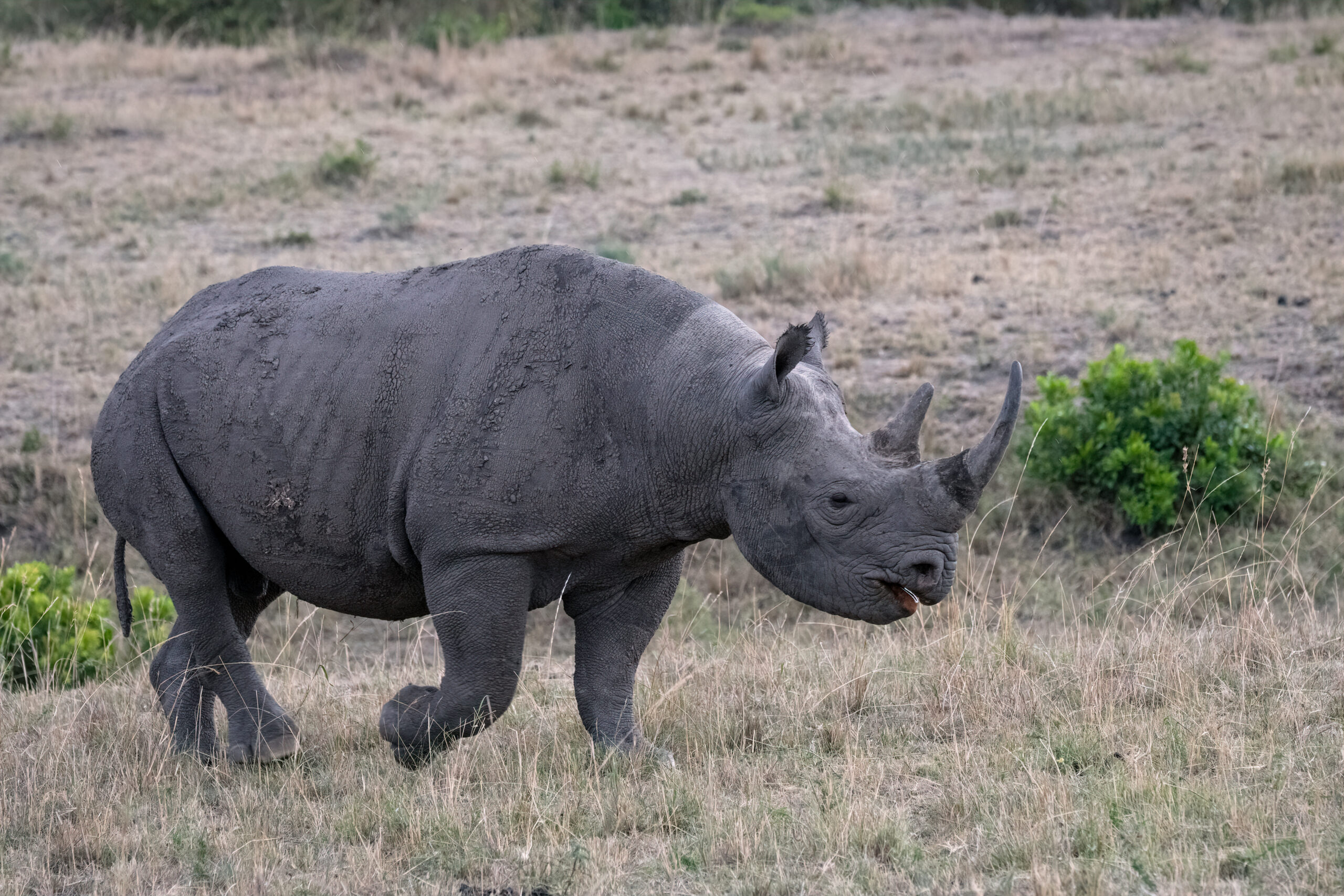
Protecting movement as well as rhinos
For decades, translocation has allowed conservationists to recreate movements that fragmented landscapes no longer permit.
The latest genomic evidence does not suggest abandoning that approach. It instead highlights the potential value of maintaining natural dispersal wherever landscapes still make it possible.
A rhino moving between two populations can introduce unrelated genes and reduce inbreeding. But if those populations become isolated again, that benefit can disappear within only a few generations.
Long-term recovery therefore requires more than occasionally moving animals between protected areas. Where possible, it requires secure landscapes in which movement and gene flow can continue naturally.
For large ecosystems such as Tsavo, protecting that connectivity may become increasingly important as black rhino populations recover.