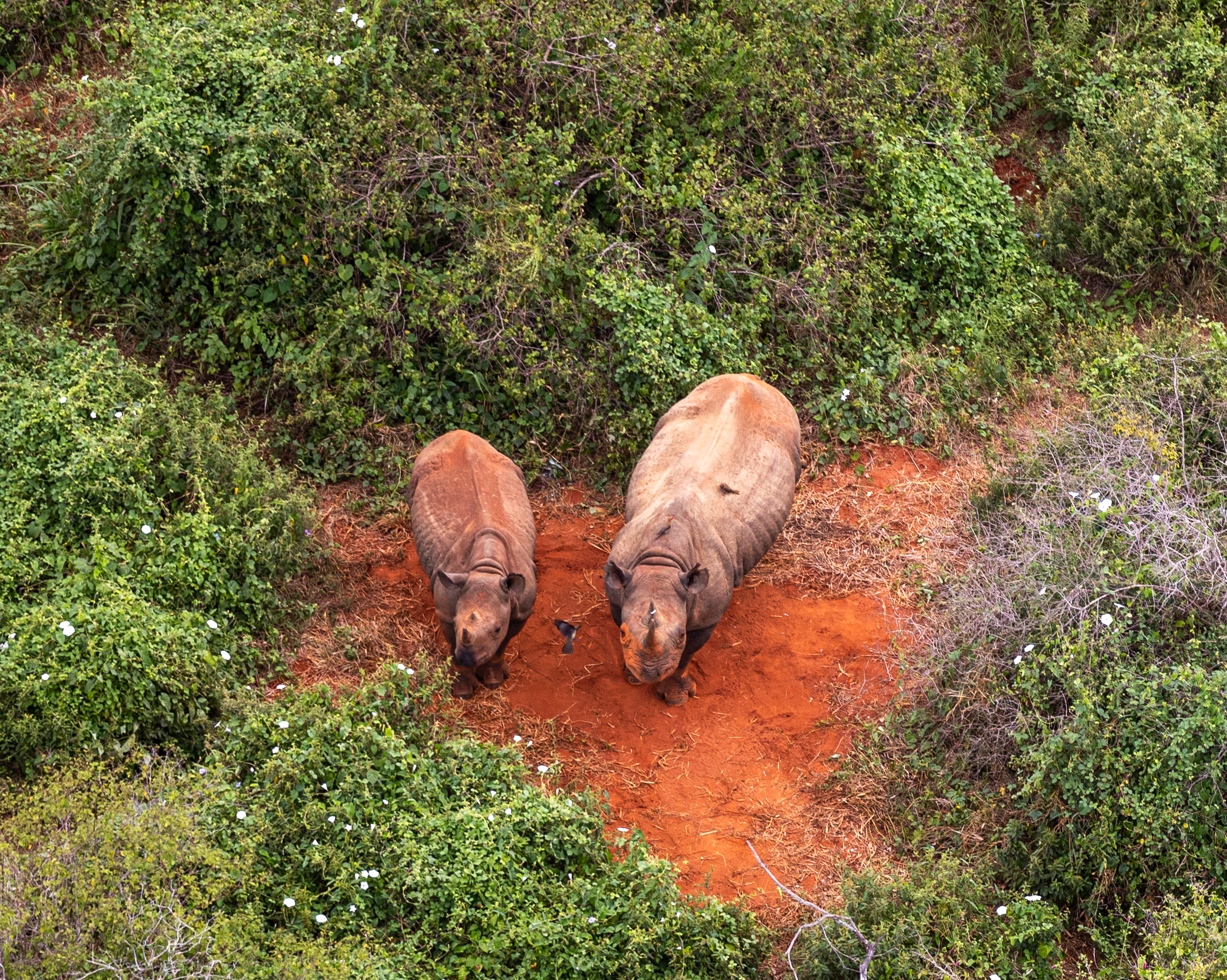
In 1989, Kenya was home to approximately 370 black rhinos. Decades of poaching had devastated populations across the country, leaving conservationists with the enormous challenge of preventing their disappearance.
Today, Kenya faces a very different conservation challenge.
According to the latest figures released by the Kenya Wildlife Service (KWS), Kenya’s black rhino population reached 1,207 individuals by September 2026, surpassing the previous national target of 1,200 ahead of schedule.
This represents a remarkable achievement for KWS, conservation organisations, private landowners and communities involved in rhino protection.
However, as populations continue to recover, an increasingly important question is emerging: where will Kenya’s growing rhino population live?
When conservation success creates new challenges
For much of the past four decades, black rhino conservation in Kenya has focused on establishing secure, intensively monitored populations within protected sanctuaries.
These sanctuaries have been instrumental in reducing poaching, encouraging reproduction and rebuilding populations that were once dangerously close to disappearing.
However, according to KWS, more than 80% of Kenya’s black rhinos now live in fenced populations that are at or above their ecological carrying capacity.
As rhino densities increase, competition for food and territory can intensify.
As we explored in our previous article on black rhino courtship and territorial behaviour, black rhinos are predominantly solitary animals that generally seek to avoid unnecessary encounters with one another. Interactions between individuals, particularly territorial males, can become highly aggressive and occasionally fatal.
In increasingly crowded sanctuaries, rhinos have fewer opportunities to avoid one another or establish new territories. Territorial encounters may become more frequent, reproductive rates can decline and population growth may eventually stagnate.
Recent developments at Ol Pejeta Conservancy illustrate the scale of this emerging management challenge. The conservancy currently holds 178 eastern black rhinos, despite an estimated ecological carrying capacity of approximately 120.
KWS has launched an audit following a number of rhino deaths recorded at the conservancy in 2026. While the investigation remains ongoing, the situation highlights the wider importance of creating additional habitat for Kenya’s recovering rhino populations.
The next phase of Kenya’s rhino recovery
In November 2026, KWS brought together conservation stakeholders to review the draft Black Rhino Recovery and Action Plan for 2027–2031.
The proposed plan aims to increase Kenya’s black rhino population to at least 1,500 by 2031 and 2,000 by 2037.
Achieving these targets will require more than maintaining existing protection efforts. It will require significant expansion of the area available to rhinos.
Through the Kenya Rhino Range Expansion initiative, KWS and its conservation partners are working towards establishing additional rhino conservation areas across northern Kenya and the Mount Kenya region.
These landscapes could provide opportunities to relieve pressure on existing populations, establish new breeding populations and restore rhinos to parts of their historical range.
Identifying suitable areas, however, is not simply a question of finding unoccupied land. Habitat quality, water availability, security, community support and the financial resources required for long-term protection must all be considered.
Could more black rhinos live in unfenced landscapes?
While establishing additional fenced sanctuaries is an important part of securing Kenya’s rhino populations, their continued recovery also raises a broader conservation question.
Could more black rhinos eventually return to large, open landscapes where they are able to disperse naturally?
The Maasai Mara provides an interesting example of what this could look like.
The reserve’s black rhino population recovered from a recorded low of approximately 11 individuals in 1984 to 54 across the reserve and Mara Triangle by the end of 2024.
Unlike many of Kenya’s rhino populations, the Mara’s black rhinos are not confined within a fenced sanctuary.
The reserve shares an unfenced international boundary with Tanzania’s Serengeti National Park, allowing rhinos to move naturally between the two countries.
According to the Maasai Mara National Reserve Management Plan, the Mara supports one of Kenya’s two remaining indigenous black rhino populations and is the country’s only unfenced, free-ranging population outside a national park.
This connectivity is particularly significant because natural dispersal can help maintain genetic exchange between populations without requiring human-managed translocations.
As we discussed in our previous article exploring the challenges of wildlife translocation, allowing animals to disperse naturally between suitable habitats can offer several advantages over human-managed relocation. However, this depends on maintaining sufficient habitat connectivity and protecting the landscapes through which animals move.
A scientific study published in Proceedings of the National Academy of Sciences in 2025, examining eastern black rhinos in the Serengeti–Mara ecosystem, highlighted the potential advantages of natural dispersal in reducing the risks associated with inbreeding.
As Kenya’s rhino population grows, assessing opportunities within landscapes such as the greater Maasai Mara, including suitable neighbouring conservancies, could form part of a wider conversation about range expansion.
Whether these areas could support additional rhinos would require thorough ecological, genetic and security assessments. Nevertheless, the Mara demonstrates that rhino conservation does not necessarily require animals to be confined within relatively small, fenced areas.
Tsavo: creating space for rhino recovery
Few landscapes demonstrate the importance of rhino range expansion as clearly as Tsavo.
The greater Tsavo ecosystem once supported more than 8,000 black rhinos. By 1989, following decades of poaching, drought and other pressures, fewer than 20 remained.
Today, Tsavo supports approximately a quarter of Kenya’s black rhino population.
An important milestone in this recovery has been the expansion of the Tsavo West Rhino Sanctuary, which now covers 3,200 square kilometres, making it the largest rhino sanctuary in the world.
Historically, many of Tsavo West’s black rhinos were concentrated within the 92-square-kilometre Ngulia Rhino Sanctuary. As the population recovered, the sanctuary became increasingly crowded, limiting opportunities for further population growth.
The expanded sanctuary provides a substantially larger protected landscape in which rhinos can establish territories, access resources and reproduce.
Although the expanded sanctuary remains fenced, its considerable size allows rhinos to move across a much larger and more ecologically diverse landscape.
Since 2013, Tsavo Trust has invested approximately $6 million in supporting KWS-led rhino conservation in Tsavo West.
This support includes aerial surveillance, ground patrols, rhino monitoring, ranger equipment, water infrastructure and the development of operational field bases.
Expanding rhino range is not simply about providing more land. It also requires expanding the conservation capacity needed to protect and manage that land.
Poaching remains a threat
Kenya’s recent conservation achievements should not be mistaken for the disappearance of the threats that originally devastated its rhino populations.
KWS reported zero rhino poaching incidents in 2025 and throughout the first nine months of 2026, an extraordinary achievement reflecting decades of investment in wildlife protection.
However, international demand for rhino horn persists, and illegal wildlife trafficking remains a significant conservation threat.
Establishing rhinos across larger, less restricted landscapes presents additional security challenges. Protecting these populations requires sustained investment in ranger capacity, surveillance, intelligence gathering, monitoring and community partnerships.
The future of black rhino conservation may increasingly involve a combination of intensively protected sanctuaries, large protected landscapes and connected areas supporting free-ranging populations.
The appropriate approach will vary according to the security and ecological conditions of each landscape.
Looking beyond population recovery
Kenya’s black rhino recovery is one of Africa’s most significant conservation achievements. However, the recovery of a threatened species should ultimately involve more than increasing its population.
It should also involve restoring its geographical range, maintaining genetic diversity and re-establishing its ecological role across suitable landscapes.
For decades, the priority was to prevent black rhinos from disappearing. While protecting them from poaching remains fundamental, Kenya is increasingly able to consider how these animals might occupy a greater proportion of their historical range.
Through initiatives such as the Tsavo West Rhino Sanctuary expansion, Kenya is already laying the foundations for this next phase of conservation.
The challenge now is to ensure that secure, suitable habitat expands alongside the black rhino population itself.
References
- KWS: Stakeholder validation workshop for the Black Rhino Recovery Plan 2027–2031
- KWS: Rhino audit at Ol Pejeta and Kenya’s Rhino Range Expansion initiative
- KWS: Kenya launches the world’s largest rhino sanctuary
- Maasai Mara National Reserve Management Plan 2023–2032
- Kenya National Wildlife Census 2025
- Natural dispersal is better than translocation for reducing risks of inbreeding depression in eastern black rhinoceros, PNAS, 2025
- Tsavo Trust: Black Rhino Support Programme