

African wild dogs are among Africa’s most social carnivores. They hunt together, raise pups cooperatively and depend heavily on other members of their pack. Yet at a certain point in their lives, many young wild dogs do something that appears to contradict this dependence on the group.
They leave.
Usually travelling with siblings of the same sex, dispersing wild dogs can abandon the territory they have known since birth and travel through completely unfamiliar landscapes in search of unrelated dogs with whom they might eventually establish a new breeding pack.
New research from Zambia has revealed just how extraordinary these journeys can be. In September 2026, researchers published records of several groups travelling thousands of kilometres through protected areas, farmland, roads and densely populated regions. One group of three males had travelled 4,126 kilometres since leaving its natal pack.
But even before these journeys were documented, one of the most remarkable wild dog dispersals ever recorded had a direct connection to Tsavo.
A wild dog originating near Loliondo in the Serengeti ecosystem travelled a cumulative 3,892 kilometres before reaching Tsavo West National Park. The straight-line distance between the two locations was only around 520 kilometres.
These movements are changing our understanding of how African wild dog populations remain connected across enormous landscapes.
Why do wild dogs leave their packs?
Other pack members play an important role in raising them. They hunt for the pack, guard pups and regurgitate food for young animals and other members that have remained at the den. But for subordinate adults, remaining within the family can provide relatively few opportunities to reproduce themselves.
Dispersal offers another possibility.
Young dogs can leave their natal pack and search for unrelated animals with whom they might form a new breeding group. Dispersal is particularly common among two- and three-year-olds and often occurs when several siblings of the same sex reach dispersal age together.
This produces an unusual system.
Rather than simply leaving home individually, wild dogs often disperse in small groups of related males or related females. Somewhere in the landscape, they must eventually encounter unrelated dogs of the opposite sex.
Finding them can involve an extraordinary journey.
More than 4,000 kilometres in search of a new home
The new research, published in Ecology, documents several remarkable movements across Zambia.
One of the first involved a three-year-old female known as EWD-1355. In October 2021, she left the Luamfwa Pack in South Luangwa National Park with two of her sisters.
Over the following 11 months, they travelled more than 2,300 kilometres.
Their route took them into Mozambique and back, across major rivers and highways, repeatedly up and down the Rift Valley escarpment, and through landscapes ranging from national parks to areas containing substantial human settlement.
Eventually, they reached the home range of a large wild dog pack in Lower Zambezi National Park. But reaching other wild dogs did not mean their search was over. They did not join the pack, nor did males from it leave to join them.
So the sisters continued moving.
Other dispersals documented since then have been even more extensive.
In July 2025, four three-year-old females left the Mayukuyuku Pack in Kafue National Park. Two weeks later, three males of the same age also dispersed from the pack.
The two groups travelled separately across central Zambia.
The males moved through largely unprotected landscapes and reached the outskirts of major cities including Kabwe, Kitwe and Ndola. When confronted with heavily developed areas, they changed direction. After approaching Ndola, for example, the males retraced almost exactly 200 kilometres of their previous route.
By April 2026, the three males had travelled 4,126 kilometres since leaving their natal territory and had settled in a new range in the Luano Game Management Area within the wider Luangwa Valley ecosystem.
Their journey is among the longest dispersal movements ever documented for an African wild dog.
One extraordinary journey ended in Tsavo
The distances recorded in Zambia are remarkable, but long-distance dispersal by African wild dogs is not confined to southern Africa.
Before these recent observations, the longest cumulative movement highlighted by the researchers was a wild dog that travelled from Loliondo, on the eastern side of the Serengeti ecosystem, to Tsavo West National Park.
The start and end points were approximately 520 kilometres apart in a straight line.
But the animal’s actual cumulative movement was approximately 3,892 kilometres.
Dispersing animals do not simply identify another wildlife population hundreds of kilometres away and travel directly towards it. They explore unfamiliar landscapes, change direction when encountering obstacles and search enormous areas for other members of their species.
For a wild dog to move between the Serengeti ecosystem and Tsavo demonstrates just how large the functional landscape of a wide-ranging carnivore can be.
On a map of national parks, the two ecosystems can appear separated.
To a dispersing wild dog, that space may still be crossable.
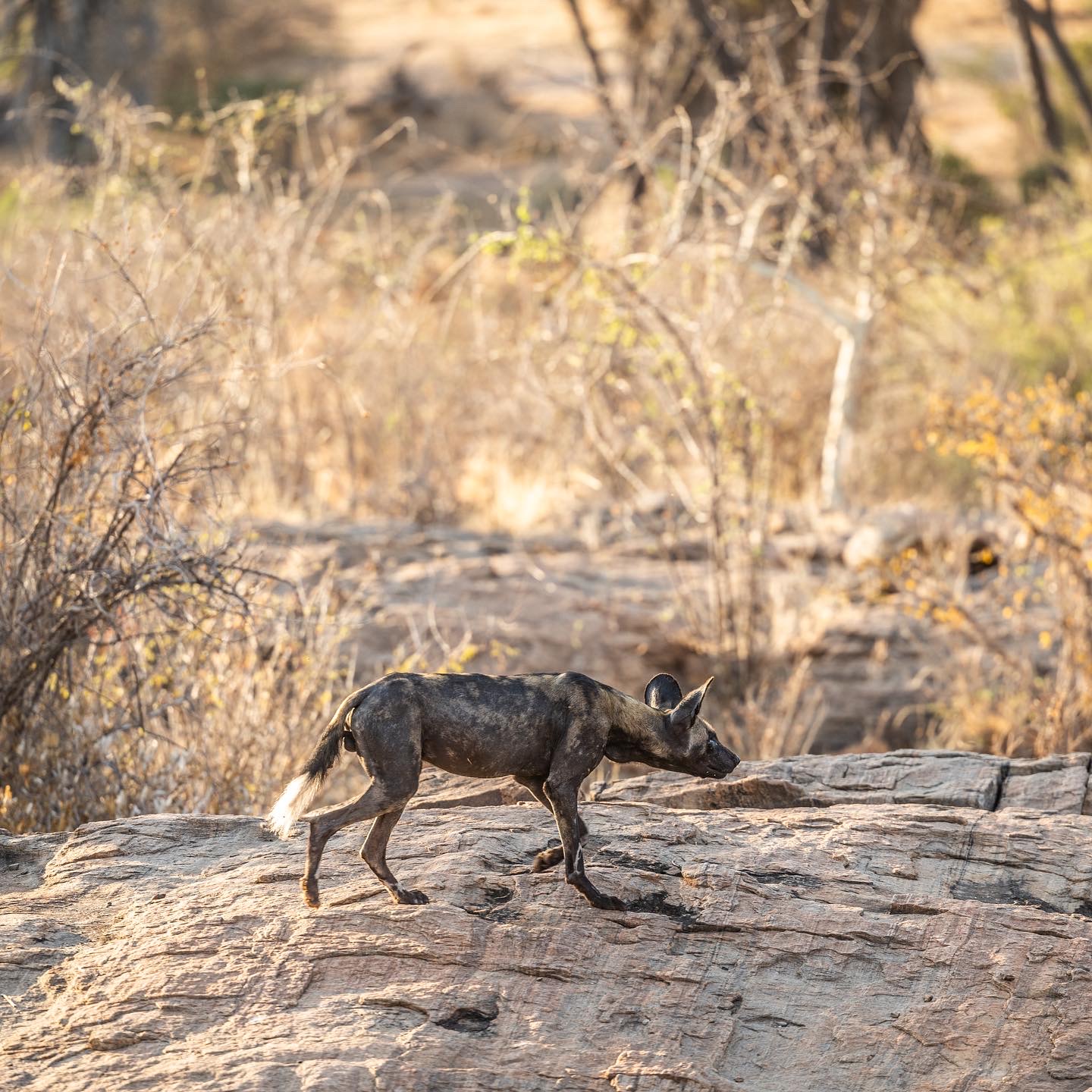
How do wild dogs cross human-dominated landscapes?
GPS tracking has shown that wild dogs outside protected areas move approximately 1.7 times faster and follow more linear routes than they typically do inside protected landscapes. Researchers measured a 2.4-fold decrease in mean turning angle, indicating considerably straighter movement.
EWD-1355 and her sisters demonstrated this behaviour during their 2,300-kilometre journey. When travelling through unprotected areas, they moved rapidly and relatively directly, resting in rocky terrain or small patches of woodland where encounters with people were less likely.
This reveals an important distinction between habitat and connectivity.
A landscape does not necessarily need to contain enough prey, water and suitable habitat to support a permanent wild dog pack in order to contribute to wild dog conservation.
Sometimes animals simply need to be able to move through it.
A relatively small woodland, an unprotected ranch or a sparsely settled area might therefore form part of a much larger network connecting wildlife populations hundreds of kilometres apart.
Did avoiding lions prepare wild dogs for avoiding people?
There may be an evolutionary explanation for this remarkable ability to cross difficult landscapes.
Despite being highly effective hunters, African wild dogs are subordinate to larger carnivores, particularly lions and spotted hyenas.
Lions can kill wild dogs, while hyenas frequently compete with them for food. Wild dogs have therefore evolved behavioural strategies that allow them to respond quickly to dangerous competitors.
Researchers have proposed what they call the competition-movement-connectivity hypothesis.
The idea is that the behavioural, physical and cognitive adaptations allowing wild dogs to move through landscapes containing lions and hyenas may also help them travel through landscapes made dangerous or unsuitable by human activity.
Wild dogs make rapid, directional movements after encountering lions. GPS tracking suggests that the fast, linear movements observed outside protected areas are broadly similar.
This does not mean that wild dogs perceive people as lions, or that researchers have demonstrated that one behaviour directly evolved into the other.
Instead, it suggests that an adaptation originally shaped by competition with other carnivores may have left wild dogs unusually capable of navigating modern, human-modified landscapes.
Finding another wild dog is only part of the challenge
Wild dogs may be capable of travelling enormous distances, but successful dispersal requires more than movement.
The Mayukuyuku males and females provide an extraordinary example.
After leaving the same Kafue pack separately, both groups travelled independently through central Zambia. Then, on 18 and 19 September 2025, they encountered one another again in an unprotected area between Kitwe and Ndola.
By then, the females had travelled 1,404 kilometres and the males 1,203 kilometres from their natal range.
Wild dogs have a highly developed ability to locate one another by scent, which is useful when pack members become separated during hunting. However, the study does not establish precisely how these two dispersing groups managed to find one another again.
More importantly, simply encountering wild dogs does not necessarily produce a new pack.
Later in their journey, the Mayukuyuku males passed within just 1.6 kilometres of a group of females that had dispersed from South Luangwa. The two groups had travelled more than 2,300 and 1,500 kilometres respectively, yet they did not successfully unite.
Unknown wild dogs can fight, sometimes fatally, when they encounter one another. Immigration and pack formation therefore remain difficult even after animals successfully cross the landscape.
The researchers make an important distinction: movement is not necessarily connectivity.
Four of the dispersing groups described in the study collectively travelled 9,863 kilometres, but at the time of the research those movements had produced little confirmed genetic or demographic connectivity.
For dispersal to truly connect populations, animals ultimately need to survive, reproduce and move genes between them.
A journey wild dogs are adapted to make, and a threat they are not adapted to recognise
Travelling thousands of kilometres through unfamiliar territory is inherently dangerous.
But one of the greatest threats encountered by dispersing wild dogs is remarkably simple: wire.
After travelling more than 2,300 kilometres, EWD-1355 was killed in June 2022 by a wire snare set for bushmeat hunting. The fate of her two sisters remains unknown.
The Mayukuyuku females appear to have encountered the same threat.
After reaching a small forested area near Kabwe, the collared female repeatedly returned to a fixed location. Researchers had previously observed similar behaviour when wild dogs remained close to a pack member caught in a snare.
Because active snares were present in the area, the researchers inferred that one of the uncollared females had probably been caught. Shortly afterwards, the collared female also died. Her collar had been cut off with a knife, and researchers concluded that she had probably also been snared. The fate of the remaining sister is unknown.
The researchers are appropriately cautious about these latter deaths because they were inferred rather than directly observed.
But the wider threat from snares is well established.
Wild dogs have evolved responses to lions, hyenas, rivers and other natural dangers. A thin loop of wire concealed in vegetation presents an entirely different problem. It is silent, difficult to detect and has no natural equivalent from which avoidance behaviour could have evolved.
Their strong social bonds can compound the danger. Wild dogs are reluctant to abandon injured pack members, meaning one snared animal can place others at risk.
What these journeys mean for wild dog conservation
African wild dogs are now distributed in fragmented populations across parts of eastern and southern Africa.
Looking at a map of those populations can create the impression that many are completely isolated.
These extraordinary movements suggest the reality may be more complicated.
In Zambia, researchers have documented movements connecting major wild dog populations across multiple national parks and wider ecosystems. Genetic research has also provided evidence that some apparently distant populations remain connected.
The authors suggest it is plausible that many wild dog populations across eastern and southern Africa remain connected through occasional long-distance dispersal, although this remains a hypothesis rather than something demonstrated for every population.
Even rare successful journeys could matter.
If an animal moves from one population, joins another and reproduces, its genes move with it. Over generations, these movements can help maintain genetic exchange between populations that might otherwise become increasingly isolated.
But the new research also demonstrates why simply recording an animal crossing between two ecosystems is not enough. Dispersers must survive the journey, encounter suitable unrelated animals, successfully establish or join a breeding group and ultimately reproduce.
Connectivity is therefore both ecological and social.
What does this mean for Tsavo?
The documented journey from the Serengeti ecosystem to Tsavo West provides direct evidence that African wild dogs can move between landscapes separated by distances that appear enormous from a human perspective.
It also demonstrates why conservation cannot end at the boundary of a national park.
Tsavo East and Tsavo West protect a vast area of habitat, but wide-ranging species move beyond protected boundaries. Ranches, conservancies, community land and other unprotected areas can form part of the landscapes through which animals disperse.
Not all of these areas need to support permanent wild dog packs to have conservation value.
Some may function as temporary refuges. Others may provide routes around settlements or physical barriers. Some may simply provide enough cover for a dispersing group to rest before continuing its journey.
The important question is whether the wider landscape remains sufficiently permeable for wildlife to move through it safely.
This changes how we should think about wildlife corridors.
A corridor does not always have to be an uninterrupted strip of pristine habitat connecting two protected areas. For a species capable of moving as African wild dogs do, connectivity can extend through a much more complicated mosaic of protected and unprotected land.
But permeability has limits.
Roads can kill dispersing animals. Livestock conflict can lead to retaliation. Bushmeat hunting can remove their prey. Snares can kill the wild dogs themselves. Expanding settlements, fencing and other barriers can eventually turn a difficult journey into an impossible one.
Protecting connectivity therefore means not only protecting habitat, but reducing the threats animals encounter while moving between major wildlife populations.
Protecting the landscape between populations
The new research reveals an extraordinary capacity for movement.
Three wild dogs can leave one ecosystem and travel more than 4,000 kilometres. Another can leave the Serengeti ecosystem and eventually reach Tsavo West. Groups can navigate highways, rivers, reservoirs, settlements and unfamiliar landscapes while searching for other members of their species.
But their ability to move does not guarantee their survival.
That distinction is central to the conservation of wide-ranging species.
Protected areas such as Tsavo provide essential strongholds, but the ecological connections between strongholds can be equally important. A landscape that appears relatively insignificant because it cannot support a permanent population may nevertheless provide the route through which the next generation of animals, and their genes, reaches another population.
African wild dogs appear remarkably capable of making these journeys.
The conservation challenge is ensuring that the landscapes between their populations remain possible to cross.
The September 2026 Ecology study, “Extraordinary movements connecting distant ecosystems by African wild dogs (Lycaon pictus)”, is available through the Ecological Society of America / Wiley.