

Across the Tsavo Conservation Area, animals can be found living in groups of almost every size and structure. African buffalo may gather in herds numbering hundreds of individuals, elephants live within long-lasting family networks, impala form different social groups according to sex and reproductive status, while giraffes regularly join and leave much more fluid associations.
From a distance, we might describe all of these animals as living in herds. From an evolutionary perspective, however, they represent very different forms of social organisation.
More eyes looking for predators
For a grazing animal, feeding and vigilance compete for time. An impala with its head down cannot monitor its surroundings as effectively as one standing upright and scanning.
Living in a group can change that calculation.
The many-eyes hypothesis proposes that as group size increases, there are more individuals available to detect an approaching predator. If animals respond to the vigilance and alarm behaviour of their neighbours, each individual may be able to spend less time scanning and more time feeding.
This relationship has been demonstrated in numerous species, although it is not universal. The benefits depend on habitat, group composition, predator behaviour and how effectively information passes between individuals.
There is also a second, related advantage known as the dilution effect. Even if a larger group does not detect a predator any earlier, an individual surrounded by many potential prey animals may have a lower probability of being selected during an attack.
This does not mean every individual within a herd experiences equal risk. Predators may preferentially target young, injured or isolated animals, while individuals at the edge of a herd may experience different risks from those towards its centre. Herd structure can therefore be almost as important as herd size.
Buffalo and collective defence
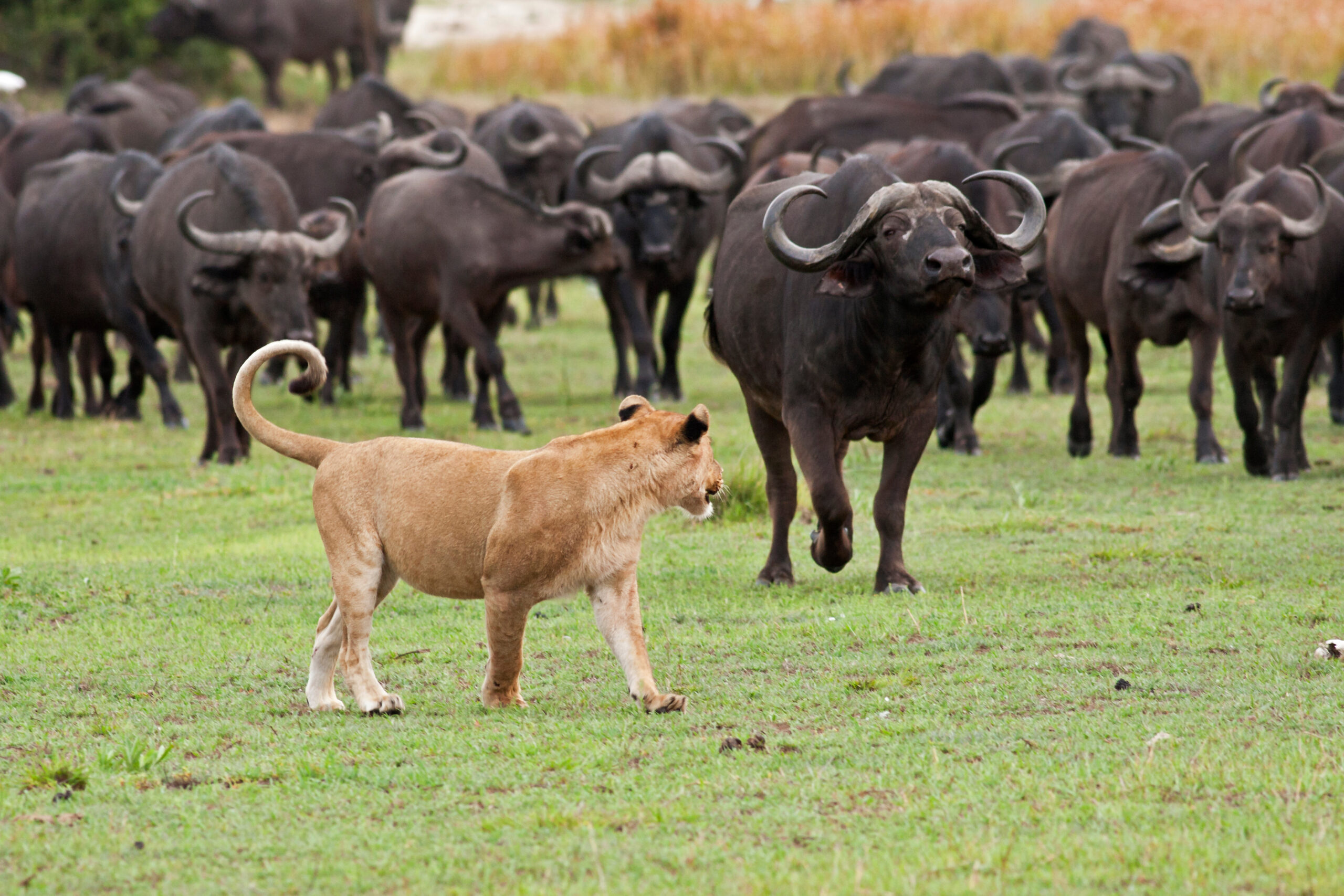
African buffalo demonstrate another potential advantage of living in a large group: the ability to actively defend one another.
Lions are capable of killing adult buffalo, but attacking an individual within a large herd presents very different challenges from attacking an isolated animal. Buffalo may respond to predators collectively, with adults approaching or confronting lions and potentially reducing the vulnerability of other herd members.
Calves can benefit particularly from remaining within the group, where they are surrounded by considerably larger adults.
Yet buffalo do not simply form the largest possible herd.
Large groups also create competition. Hundreds of buffalo feeding together can rapidly consume available forage, and individuals must continually balance the advantages of group protection against access to food and other resources.
This helps explain an important principle of animal sociality: the optimal group size is rarely the largest possible group.
Environmental conditions continually alter the balance.
A herd does not have to contain one species
One particularly interesting feature of African savannas is the prevalence of mixed-species groups.
Zebra, wildebeest, gazelles, giraffes and other herbivores regularly associate with animals belonging to other species. In some circumstances, this allows an animal to gain many of the anti-predator advantages of a larger group without necessarily competing with every neighbour for exactly the same resources.
Research on Thomson’s and Grant’s gazelles in the Serengeti provides a particularly good example.
The two species frequently form mixed groups. Researchers found that Thomson’s gazelles joining Grant’s gazelles benefited from improved predator detection and experienced lower vulnerability to cheetah attacks. Cheetahs were less successful when attacking larger groups and showed a tendency to avoid them. Thomson’s gazelles were also able to share some of the work of vigilance with Grant’s gazelles, leaving more time for feeding.
Interestingly, the benefits worked in both directions. Cheetahs preferred the smaller Thomson’s gazelles as prey, meaning Grant’s gazelles experienced a lower attack rate when mixed with them.
This demonstrates that mixed-species herding can be considerably more sophisticated than simply having more animals nearby.
What about young Grant’s gazelles?
There is an intriguing field observation associated with these mixed groups.
Adult Grant’s gazelles are substantially larger than Thomson’s gazelles, meaning that a young Grant’s can be similar in size to an adult Thomson’s, and also look very similar. Juvenile Grant’s are sometimes seen within groups of Thomson’s gazelles.
It has been suggested that this association could make the young Grant’s appear less conspicuous as a juvenile among animals of similar body size, potentially reducing its attractiveness as an apparently young and vulnerable target.
It is an interesting hypothesis, but importantly, it should not yet be treated as an established anti-predator strategy. The well-supported evidence demonstrates that Grant’s and Thomson’s gazelles gain anti-predator benefits from mixed-species grouping; the idea that juvenile Grant’s specifically exploit their resemblance in size to adult Thomson’s requires further research.
Distinguishing between plausible field observations and experimentally supported explanations is an important part of behavioural ecology.
Different species can provide different information
Mixed groups also raise an interesting question: does every pair of eyes contribute equally?
Probably not.
Different species possess different sensory abilities, feeding behaviours and fields of view. A grazing animal spends substantial periods with its head close to the ground. A giraffe, meanwhile, may have its head several metres above the surrounding vegetation.
Animals can also react to the behaviour of other species. A sudden alarm, movement or change in posture from one species can provide information to others that a threat may be nearby.
Ecologists sometimes describe information obtained by observing other animals as public information.
This means a mixed herd can potentially operate as a network in which several species contribute different types of information about their surroundings.
Exactly how much individual species benefit from particular mixed-species associations remains an active field of research. It is not enough to assume, for example, that smaller herbivores deliberately associate with giraffes because giraffes can see farther. Demonstrating that relationship requires showing that association actually changes predator detection or survival.
Zebra and wildebeest: sharing the same landscape differently
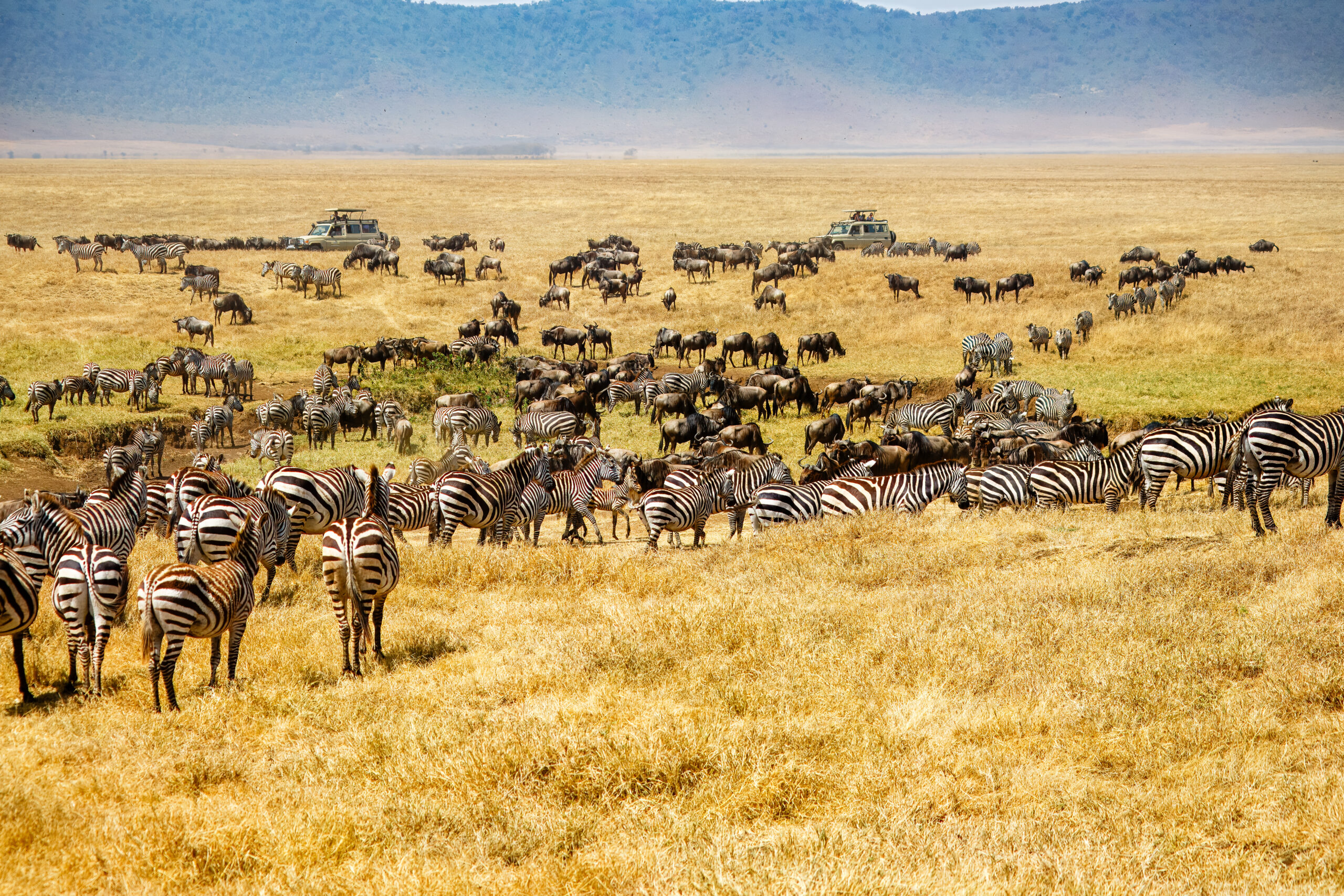
Zebra and wildebeest provide another familiar example of mixed-species aggregation.
Both are grazers, but they do not exploit vegetation in exactly the same way. Zebra are capable of processing relatively coarse, fibrous grasses, while wildebeest are more selective feeders and generally favour shorter, higher-quality vegetation.
Consequently, sharing a landscape does not necessarily mean competing equally for every mouthful of grass.
Mixed groups may also increase the number of animals available to detect predators. The precise benefits vary according to environmental conditions, however, and large mixed aggregations should not automatically be interpreted as permanent social relationships.
This distinction is important.
A thousand herbivores concentrated around water or fresh grazing may be an aggregation, brought together temporarily by a shared resource. An elephant family that has lived together for decades represents a very different biological phenomenon.
Both look like herds. Only one is built around persistent social relationships.
Elephants: when a herd becomes a knowledge network
Female African elephants usually remain within their natal social networks throughout their lives. Mothers, daughters, sisters and other relatives form family units whose relationships can persist for decades.
This creates an opportunity for information to accumulate across generations.
Older matriarchs can possess substantially greater social experience than younger females. For a long-lived and highly intelligent species, this has important consequences. An individual does not have to learn everything independently. Information about other elephants, threats and the wider environment can be acquired socially and retained within the family.
This is one reason why elephant populations cannot always be understood simply by counting individuals. The age and social composition of a population matter too.
For Tsavo Trust, long-term identification and monitoring of elephants provides an opportunity to understand individuals as members of these wider social networks. Following known animals over many years can reveal relationships and changes that a single population count cannot.
Older bulls have a different social system from female family groups, but experience matters there too. Mature males can influence the social development and behaviour of younger bulls, adding another dimension to the importance of protecting elephants through their full natural lifespan.

Giraffes: a very different kind of herd

For many years, giraffes were sometimes described as having relatively loose and unstructured social relationships. Long-term research has revealed a considerably more complex picture.
Giraffes live within a fission-fusion social system. Groups repeatedly form, split and reform, and membership can change frequently.
Yet fluid does not mean random.
Individual giraffes can maintain preferred social associations, and reproductive status can influence these relationships. Research on Masai giraffes found that females with dependent offspring maintained stronger associations than females without offspring. Calves and juveniles also retained relationships within nursery groups.
Giraffes therefore demonstrate that animals do not need to remain in a permanent herd for social relationships to matter.
Impala: when group structure changes with reproduction
Impala add another layer to the picture because their social organisation changes according to sex, season and reproductive status.
Female impala commonly live in herds, while males may occupy bachelor groups or become territorial. During reproductive periods, males compete for access to females, and the balance between territoriality and group living can change.
A bachelor herd therefore serves a different function from a female herd containing young.
This illustrates why the term “herd” can conceal considerable biological complexity.
Group membership can influence protection from predators, access to food, competition for mates and eventually reproductive success. The relative importance of each factor changes throughout an animal’s life.
Why live together?
There is no single explanation for why African animals form herds.
For some species, collective vigilance and reduced predation risk are particularly important. For others, groups provide collective defence, reproductive opportunities, assistance with raising young or access to information that no individual could accumulate alone.
Often several of these benefits operate simultaneously.
They must also continually be balanced against the costs of competition, disease and social conflict.
A buffalo herd, an elephant family, a temporary gathering of gazelles and a shifting group of giraffes may appear superficially similar when viewed across the savanna. Biologically, however, they represent very different solutions to the same evolutionary problem:
When is an animal better off living with others than living alone?