

Get close to an elephant, a giraffe, a hippo, or even an ostrich, and one thing becomes immediately obvious: Africa is home to some truly enormous animals.
The African savanna contains the largest land animal on Earth, the tallest animal on Earth, the heaviest bird on Earth, and some of the largest herbivores and predators ever to evolve. While giant animals once existed across much of the world, today Africa remains one of the last places where a remarkable diversity of megafauna still survives.
But why do some animals become giants in the first place? What advantages come with weighing several tonnes, growing six metres tall, or standing higher than any other animal on the planet?
The answer lies in millions of years of evolution.
The advantages of being big
Growing large requires enormous amounts of food and energy. Evolution would not favour giant size unless it provided significant benefits.
One of the biggest advantages is protection from predators.
A fully grown elephant has virtually no natural predators. Adult hippos are rarely attacked, and even buffalo become difficult and dangerous prey once they reach maturity. Size provides security. A larger animal can defend itself more effectively and is less vulnerable to attack.
This allows adults to invest more energy into feeding, reproduction, and raising offspring rather than constantly avoiding predators.
Size also helps animals compete with one another. Larger individuals often gain access to better resources, dominate rivals, and secure more breeding opportunities.
For male elephants, size can determine success during competition for mates. The largest bulls often dominate access to females, particularly during musth. Similar patterns occur in buffalo and many other large mammals.
Reaching food others cannot
In some species, giant size provides access to resources unavailable to smaller animals.
Giraffes are perhaps the most obvious example. Their extraordinary height allows them to browse leaves that few other herbivores can reach. While antelope and zebras feed lower down, giraffes can exploit food resources several metres above the ground.
This reduces competition and allows giraffes to occupy a unique ecological niche.
Elephants also benefit from their size. Their height and strength allow them to push over trees, break branches, and reach vegetation that would be inaccessible to most herbivores.
In both cases, being large opens up feeding opportunities that smaller animals cannot exploit.
Staying cool in a hot world
At first glance, giant animals might seem poorly suited to Africa’s heat. In reality, large size offers some important thermal advantages.
Large animals have a lower surface area relative to their body volume than small animals. This means they gain and lose heat more slowly.
An elephant does not heat up as quickly as a small antelope standing in the same sunlight. Likewise, it loses heat more slowly during cool nights.
This thermal stability can be advantageous in environments where temperatures fluctuate significantly.
Of course, large animals still need specialised adaptations. Elephants use their enormous ears as radiators to shed excess heat. Hippos spend much of the day submerged in water, while buffalo seek shade during the hottest hours.
Their size helps regulate temperature, but behaviour remains important.
Why Africa still has giants
Perhaps the more interesting question is not why giant animals evolved, but why so many still survive in Africa.
For most of Earth’s history, large animals were widespread.
North America once supported mammoths, mastodons, giant ground sloths, giant bison, and enormous camels.
Europe had mammoths, giant deer, cave bears, and woolly rhinoceroses.
South America was home to giant sloths weighing several tonnes and armadillo relatives the size of small cars.
Most of these animals disappeared relatively recently in geological terms.
While climate change played a role, growing evidence suggests that the arrival and expansion of humans contributed significantly to many megafaunal extinctions around the world.
Large animals reproduce slowly, require extensive habitat, and are often easier to locate and hunt than smaller species. Once populations begin to decline, recovery can be difficult.
Africa appears to have avoided the worst of these extinctions partly because humans and African megafauna evolved alongside one another for millions of years. Many African species therefore had much longer to adapt to human presence and predation.
As a result, Africa remains one of the last great strongholds of large terrestrial animals.
The largest animals in Africa
Today, Africa still supports an extraordinary collection of giants.
African elephants are the largest land animals on Earth, with bulls exceeding six tonnes and occasionally approaching seven.
Hippos rank among the heaviest mammals in Africa and can weigh more than 1,500 kilograms.
Cape buffalo can exceed 800 kilograms and are among the most formidable herbivores on the continent.
Giraffes stand up to six metres tall, making them the tallest animals ever to walk the Earth.
Ostriches are the largest birds alive today, with males reaching well over 100 kilograms and running at speeds exceeding 70 kilometres per hour.
Each represents a different evolutionary solution to survival, yet all demonstrate the advantages that large size can provide.
When size becomes extreme: the Super Tuskers
Among elephants, size itself can reach extraordinary extremes.
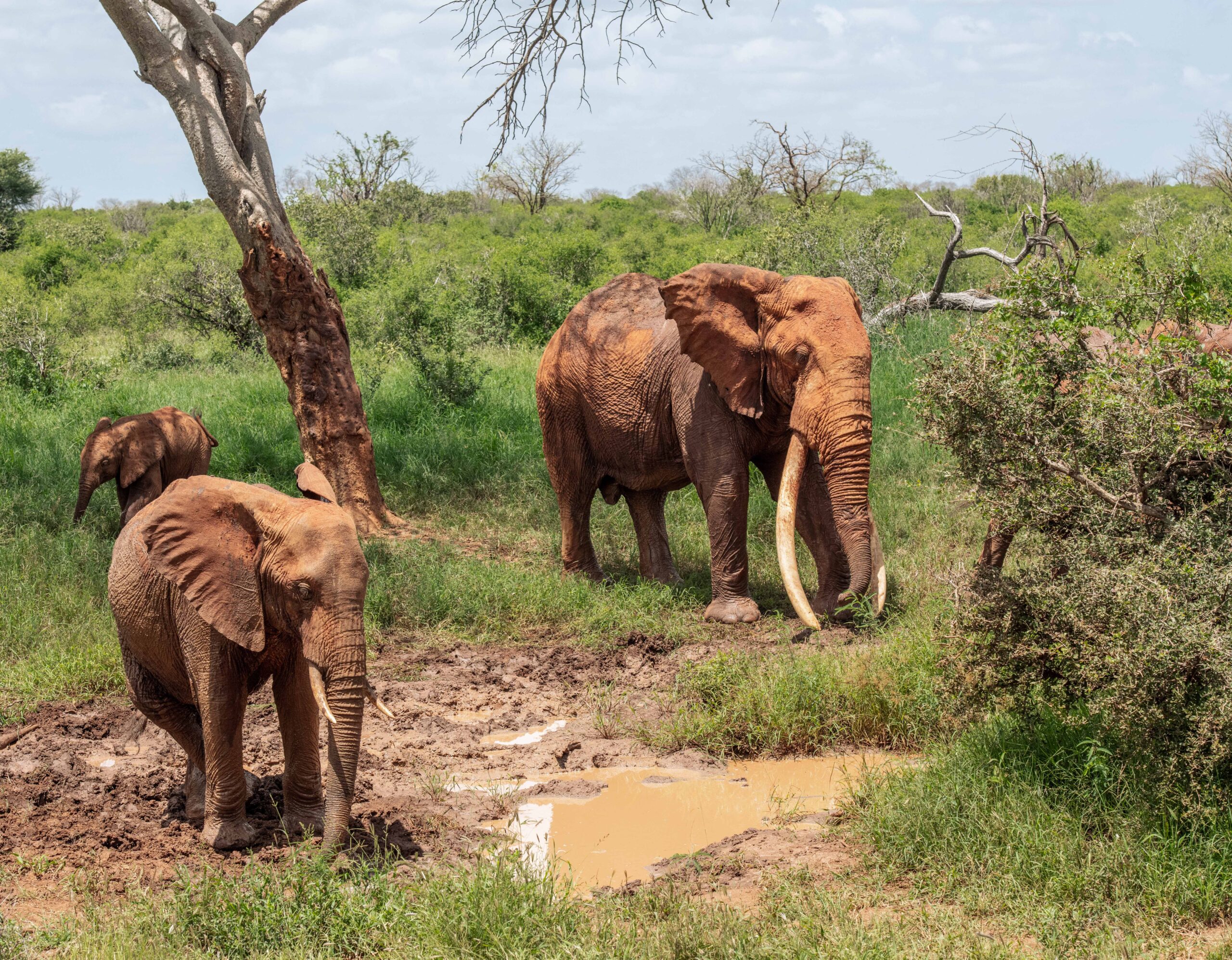
The Super Tuskers of Tsavo and a handful of other East African populations represent some of the largest and oldest elephants remaining on Earth. These bulls carry tusks weighing more than 100 pounds each, a trait that has become increasingly rare following centuries of ivory hunting.
Super Tuskers are not a separate species or subspecies. They are the product of exceptional genetics, favourable environmental conditions, and, perhaps most importantly, survival.
An elephant must live for many decades to develop tusks of this size. In many parts of Africa, intense historical hunting removed bulls long before they could reach such ages.
Tsavo remains one of the last strongholds where enough elephants survived for these remarkable individuals to persist.
In many ways, Super Tuskers represent the ultimate expression of the evolutionary forces that favour size. Larger bulls are often more successful in competition, survive droughts more effectively, and dominate rivals during musth. Given enough time, some individuals grow into giants even among giants.
Giants shape ecosystems
The influence of large animals extends far beyond their own survival.
Hippos transport nutrients between land and rivers.
Buffalo influence grazing patterns.
Giraffes affect tree growth and browsing pressure.
Even ostriches alter seed dispersal and vegetation dynamics through their feeding habits.
Because of their size, these animals interact with the environment on a scale that smaller species simply cannot match.
Remove the giants, and ecosystems begin to change.
Final thoughts
The giants of Africa are more than biological curiosities. They are the result of millions of years of evolution, shaped by competition, predation, climate, and opportunity.
While giant animals once roamed much of the world, Africa remains one of the few places where a rich community of megafauna still survives. From elephants and hippos to giraffes, buffalo, and ostriches, these animals continue to shape the landscapes around them.
In Tsavo, nowhere is this more apparent than in the Super Tuskers. These extraordinary elephants remind us not only of how large animals can become, but of what is still possible when wildlife is given the space and protection needed to thrive.
Protecting Africa’s giants means protecting some of the last living representatives of a world that was once far more common.