

Across the savannas of Africa, oxpeckers can often be seen perched atop rhinos, buffalo, and giraffes, alert, busy, and seemingly helpful. In Swahili, they are known as Asikari wa kifaru, “the rhino’s guard,” a name reflecting a long-held belief in their protective partnership with large mammals. For generations, oxpeckers were celebrated as perfect examples of mutualism, two species helping one another to survive. But recent research suggests that this relationship is far more complicated, and perhaps not as friendly as once thought.
The two oxpecker species
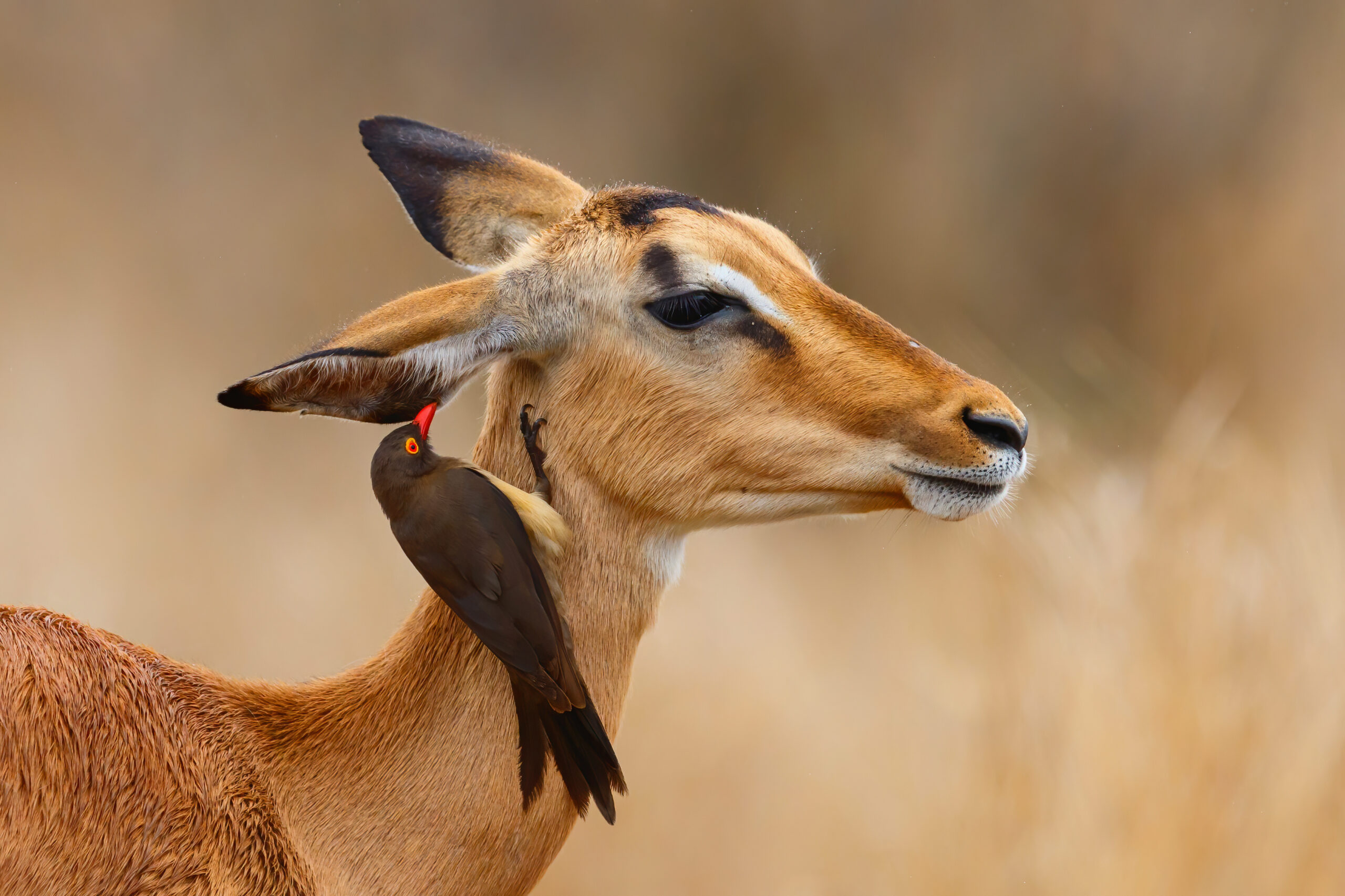
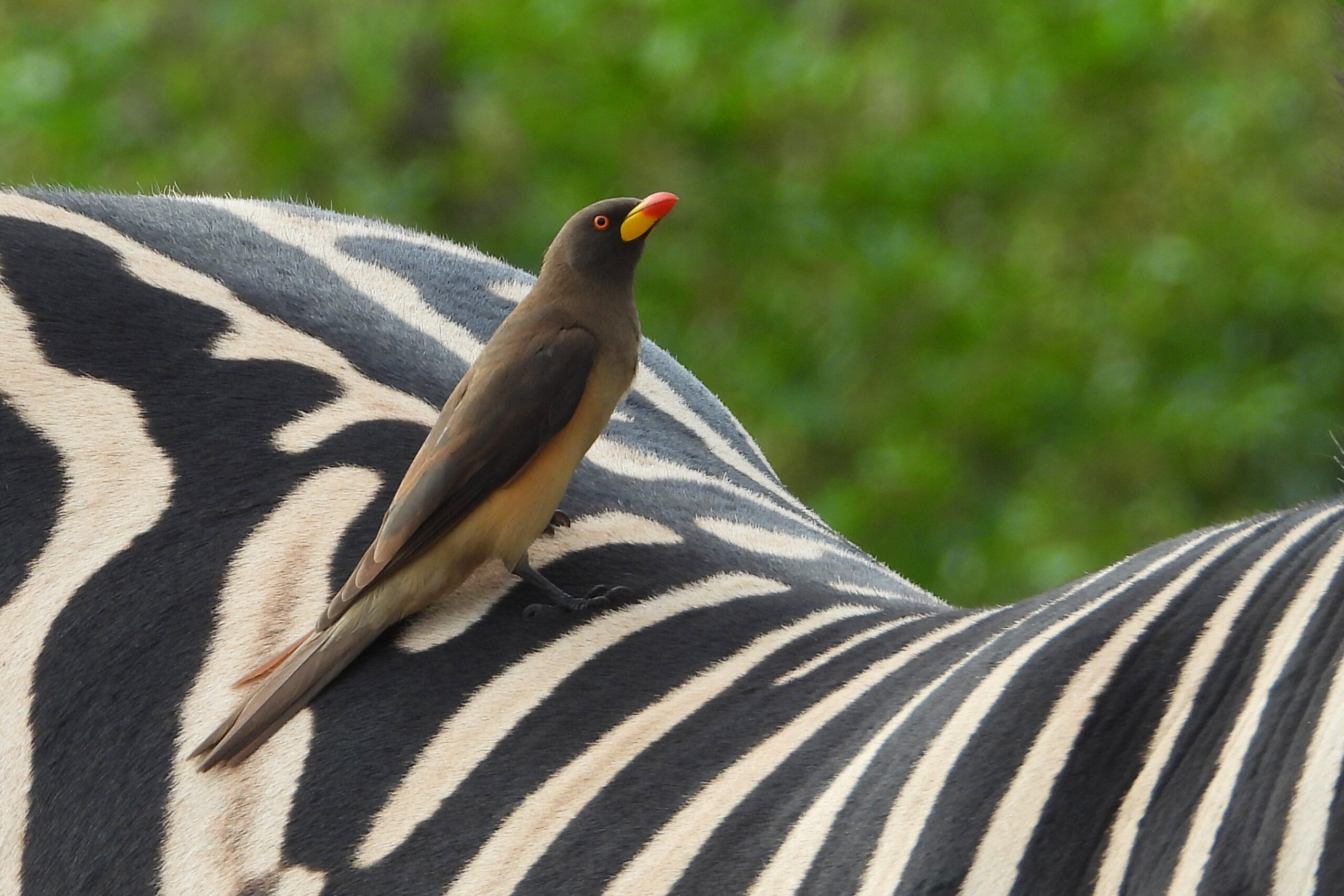
The red-billed oxpecker (Buphagus erythrorhynchus) is common across East Africa, including the Tsavo Conservation Area. These birds are identified by their red bills and yellow eyes and are frequently seen on buffalo, giraffes, zebras, and rhinos. The yellow-billed oxpecker (Buphagus africanus) has a yellow-tipped red bill and often associates with cattle and other domestic animals, though its range overlaps with its red-billed relative in parts of Kenya.
A changing picture: When helpers become parasites
For decades, oxpeckers were considered classic examples of mutualism, a win–win relationship between two species. They were thought to benefit their hosts by removing ticks and ectoparasites, reducing disease risk, feeding on dead skin and insects caught in their hosts’ hair, and acting as sentries that sound alarm calls when predators or humans approach. Many large herbivores, such as rhinos and buffalo, appear to tolerate or even welcome their presence, allowing oxpeckers to climb across their bodies unhindered.
However, new research paints a more complex picture. While oxpeckers do eat ticks, studies show that many of these ticks have already fed, meaning the birds may gain nutrition without providing real health benefits to their hosts. In fact, no statistically significant link has been found between oxpecker presence and reduced parasite loads on large mammals. Field observations reveal that oxpeckers sometimes peck at open wounds, keeping them raw or even enlarging them to access blood. They have also been seen to create new wounds by breaking the skin and to feed on earwax, dandruff, and dried skin, behaviours that benefit the birds but can irritate or harm their hosts. These findings suggest that oxpeckers may at times behave as parasites rather than partners, using large mammals as a convenient food source.
Host tolerance
Host tolerance varies widely. Some animals, such as elephants and certain antelope, actively dislodge oxpeckers when they attempt to land, apparently finding their pecking intolerable. Yet there are also recorded instances of elephants allowing oxpeckers to feed on external parasites, suggesting that even within a single species, these relationships can fluctuate between cooperation and conflict. Together, these discoveries reveal that the oxpecker’s role is far from straightforward. Rather than being permanent allies or adversaries, they occupy a middle ground, opportunistic partners whose relationship with their hosts shifts depending on circumstance.
Despite these parasitic tendencies, oxpeckers still play a useful role in some contexts. They are highly vigilant birds, giving sharp alarm calls that alert their hosts to danger. In one Kenyan study, black rhinos with oxpeckers detected approaching humans at nearly twice the distance compared to those without them. For animals with poor eyesight, like rhinos, these birds can function as an early-warning system, potentially preventing surprise encounters with people or predators.
Oxpeckers in Tsavo
Both red-billed and yellow-billed oxpeckers occur across the Tsavo Conservation Area. They are often seen with buffalo, giraffes, eland, zebras, and rhinos, and their presence can indicate healthy herbivore populations. Tsavo Trust’s aerial teams frequently spot oxpeckers during wildlife monitoring flights, their sharp calls and movements often betraying the presence of large mammals below.
A symbol of Africa’s complexity
Oxpeckers do act as guards in some ways, warning their massive hosts of danger. But they can also inflict harm, feeding from the very animals that carry them. Like many relationships in nature, the bond between oxpecker and host is not purely good or bad, but a delicate balance of cooperation and conflict, a reminder that even the smallest creatures can have complex roles in the web of life.
Understanding this relationship helps conservationists interpret animal behaviour and health more accurately. It also reveals how changing herbivore populations affect dependent species like oxpeckers, and reminds us that ecosystems depend on balance, not perfection. Every species, from rhinos to their feathered followers, plays a role in Tsavo’s living landscape.