

Africa is home to an extraordinary diversity of snakes, with more than 400 species recorded across the continent. Kenya alone hosts over 130 of them, ranging from harmless house snakes to highly venomous black mambas. These reptiles thrive in warm climates, which are essential to their survival. Being cold-blooded (ectothermic) animals, snakes cannot regulate their internal body temperature, instead, they rely on external sources like sunlight or warm rocks to stay active. This is why snakes are often seen basking in the morning sun or seeking shade during the midday heat.
In the Tsavo Conservation Area (TCA), which spans more than 42,000 km², it is difficult to know exactly how many snake species live here. The landscape is immense, varied, and in many places, remote – making encounters rare and documentation challenging. However, thanks to confirmed sightings from rangers, field teams, and community members, we now have a growing record of Tsavo’s snakes. This article highlights confirmed species observed in the region and explores the essential role they play in the ecosystem.
Snakes are a vital part of Africa’s biodiversity. They control rodent and insect populations, recycle nutrients through the food web, and serve as prey for birds, mongooses, and other carnivores. Yet for people living near wildlife areas, snake encounters can be dangerous, a challenge Tsavo Trust continues to address through education, practical conservation, and coexistence initiatives.
The venomous residents
Black Mamba (Dendroaspis polylepis)
Africa’s longest venomous snake, reaching up to 4.5 metres. Shy but fast, the black mamba’s neurotoxic venom is among the most potent in the animal kingdom. It preys on small mammals and birds. In Tsavo, it is one of the most commonly encountered species removed by Tsavo Trust’s team from community areas.
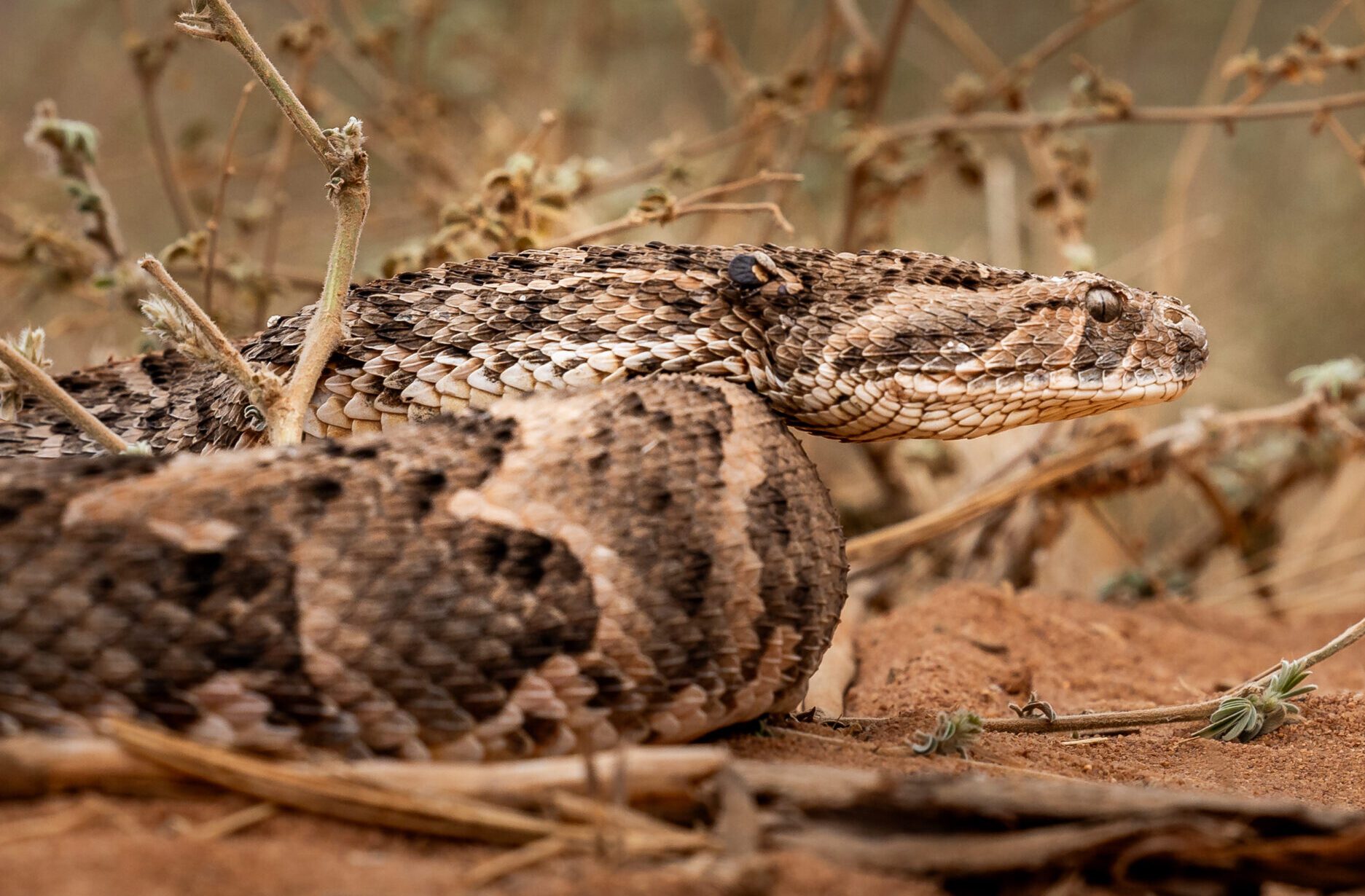
Puff Adder (Bitis arietans)
A master of camouflage and one of Africa’s most widespread snakes. It rarely moves far and relies on ambush hunting. Puff adders deliver a powerful cytotoxic bite when threatened — and, like black mambas and red-spitting cobras, are among the most frequently relocated by Tsavo Trust.
Red Spitting Cobra (Naja pallida) & Ashe’s Spitting Cobra (Naja ashei)
Both species are capable of projecting venom accurately toward the eyes of perceived threats. Ashe’s spitting cobra, the largest of its kind, was relocated by the Tsavo Trust team from a community in August 2025. These snakes are often found in scrubland and open bush, where they help regulate rodent populations.
Boomslang (Dispholidus typus)
Slender, tree-dwelling, and highly venomous, the boomslang uses potent hemotoxic venom to hunt birds and chameleons. Despite its dangerous bite, it is shy and rarely aggressive. A boomslang was safely removed from a community by Tsavo Trust in January 2025.
Small-scaled Burrowing Asp (Atractaspis microlepidota)
A secretive burrower rarely seen above ground. It has unique sideways-firing fangs that allow it to strike even in tight spaces. This elusive species was among those safely removed from a community area by Tsavo Trust.
Non-venomous and mildly venomous snakes
Spotted Bush Snake (Philothamnus semivariegatus)
A striking green, non-venomous tree snake often found near rivers and vegetation, feeding on frogs and lizards.
Red-Spotted Beaked Snake (Rhamphiophis rubropunctatus)
Recognised by its reddish snout, this mildly venomous but harmless snake thrives in dry, open areas.
Speckled Sand Racer (Psammophis punctulatus)
A quick-moving diurnal hunter that uses mild venom to capture small prey such as lizards.
Eastern Rufous Beaked Snake (Rhamphiophis rostratus)
Adapted to sandy terrain, it uses its pointed snout to burrow and uncover insects and small rodents.
Smith’s Racer (Platyceps brevis smithii)
A fast, agile snake often found in rocky or open habitats. Non-venomous and harmless, it primarily feeds on lizards and small rodents.
The biggest
African Rock Python (Python sebae)
Africa’s largest snake, sometimes exceeding five metres in length. Non-venomous but immensely strong, it kills by constriction, feeding on small antelope, birds, and monkeys. Often found near waterholes and rocky escarpments.
Secretive and lesser-known snakes
East African Sand Boa (Eryx colubrinus) – a small, burrowing species that spends most of its life underground.
Brown House Snake (Boaedon capensis) – harmless and beneficial, often found around human settlements feeding on rodents.
Parker’s Worm Snake (Myriopholis parkeri) – a tiny, blind burrower that feeds on ants and termites.
Eastern Stripe-Bellied Sand Snake (Psammophis orientalis) – a fast, day-active species adapted to open, sandy plains.
Living alongside snakes: Tsavo Trust’s community approach
While snakes can pose a risk to people, it is often snakes that lose their lives in encounters with humans. Many are killed on sight, even harmless or beneficial species, out of fear or misunderstanding. To address this, Tsavo Trust launched a proactive snake mitigation initiative aimed at reducing danger while protecting biodiversity.
In 2018, Tsavo Trust partnered with the Taylor Ashe Anti-Venom Foundation to train local snake-handling specialists from Kamungi Conservancy. After completing a three-year program, these specialists began responding to snake encounters, removals, and bite incidents across Kamungi, Voi, and Rukinga.
Since 2022, Tsavo Trust’s team has safely removed over 140 snakes from community homesteads, preventing potential bites and reducing unnecessary snake killings. Puff adders, black mambas, and red-spitting cobras are among the most common species handled by the team. Each snake is safely relocated back into the wild, contributing to both human safety and species conservation.
This initiative was recently recognised by local community members as one of the top positive impacts in the Social Assessment for Protected Areas (SAPA) for Kamungi Conservancy, underscoring Tsavo Trust’s dual commitment to community well-being and wildlife conservation.
Why snakes matter
- Pest control: Snakes regulate rodent and insect populations, preventing crop damage and disease spread.
- Ecosystem balance: They play key roles as both predators and prey in Tsavo’s food web.
- Environmental indicators: Healthy snake populations reflect a balanced, functioning ecosystem.
Safety and coexistence tips
- Give snakes space — most will flee when left undisturbed.
- Avoid walking through tall grass or reaching into holes without looking first.
- Do not attempt to handle or kill snakes.
- In the event of a bite, stay calm, minimise movement, and seek medical help immediately.
Snakes are an integral part of Tsavo’s natural heritage – ancient, adaptable, and ecologically vital. From the stealthy puff adder to the agile boomslang, each species contributes to the balance of life in this vast ecosystem.
Through ongoing monitoring, safe removals, and education initiatives, Tsavo Trust is helping people and snakes coexist safely – ensuring that both communities and wildlife can thrive together in Kenya’s largest wilderness.