

Hyenas are among Africa’s most misunderstood carnivores. Too often reduced to their reputation as scavengers, they are in fact a remarkably diverse family with intelligence, adaptability, and complex social systems that rival many of the savanna’s more celebrated predators. In this article we have a look at all the hyena species of Africa and what makes them so unique?
The Hyena family tree (Hyaenidae)
Hyenas belong to the family Hyaenidae, within the order Carnivora. Despite their dog-like appearance, they are actually more closely related to cats and mongooses, falling under the suborder Feliformia.
Once, hyenas roamed across Africa, Asia, Europe, and even North America. During the Ice Age, cave hyenas (Crocuta crocuta spelaea) thrived in Europe and Asia. These powerful hunters lived in packs, competed with wolves, and even contended with early humans for prey and shelter. Fossils of cave hyenas are found from France to Siberia, evidence of a once global distribution.
Today, only four species survive, and all of them live in Africa, with one also stretching into Asia.
Hyenas vs. Canines
At first glance, hyenas resemble large, sloping-backed dogs. They share some similarities with canines, including social hunting, scavenging, and strong teeth. But key differences set them apart:
Bone-crushing ability: Hyenas have some of the strongest jaws in the animal kingdom, able to pulverize bones and digest skin, hooves, and horn.
Unique build: Their longer forelimbs and shorter hindlimbs give them a sloping back, a gait unlike that of dogs.
Complex societies: Especially in spotted hyenas, clan structures can be larger and more hierarchical than wolf packs.
In short, hyenas are not “African dogs”, they are an entirely unique lineage of carnivores, evolved to fill ecological niches like no other.
The four living Hyena species
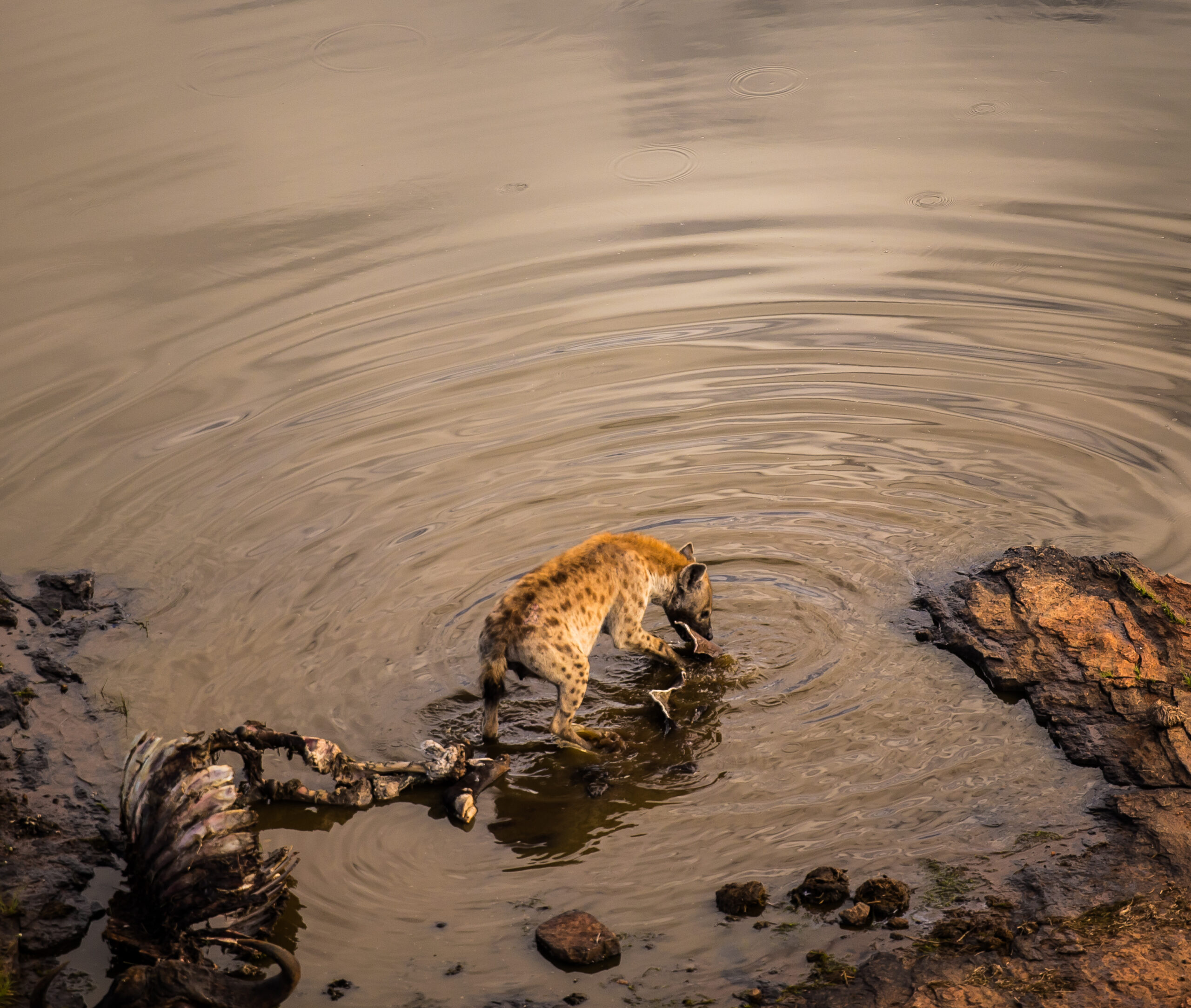
1. Spotted Hyena (Crocuta crocuta)
Size & range: The largest species, widespread across sub-Saharan Africa, including Tsavo.
Social structure: Famous for matriarchal clans where females dominate males, and social rank dictates access to food.
Feeding: Both hunters and scavengers, research shows they hunt up to 90% of what they eat.
Special traits: Strongest bite force relative to size of any mammal. Known for “laughing” vocalizations that carry messages about status and alarm.
Conservation status: Least Concern, but often persecuted due to conflict with livestock owners.
2. Striped Hyena (Hyaena hyaena)
Appearance: Medium-sized, with vertical stripes and a bushy mane that can be raised in threat displays.
Range: North and East Africa, the Middle East, and parts of India.
Lifestyle: Mostly solitary and nocturnal, rarely seen in large groups. Primarily scavengers.
Conservation status: Near Threatened, with habitat loss and persecution as primary threats.

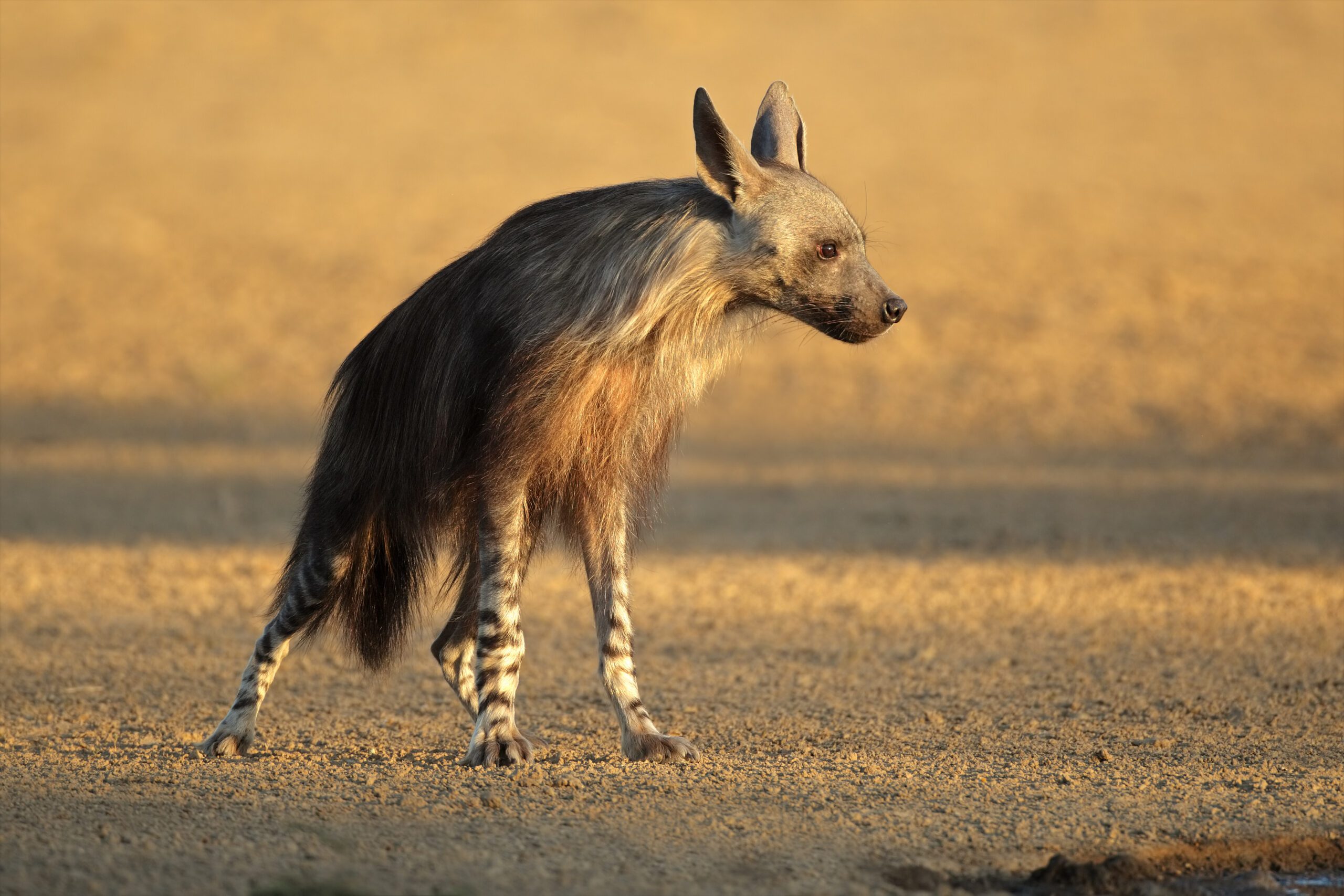
3. Brown Hyena (Parahyaena brunnea)
Appearance: Shaggy dark-brown coat with a mane of long fur.
Range: Southern Africa, especially in Namibia, Botswana, and South Africa.
Habitat: Deserts and coastal areas. Known to scavenge seal carcasses along shorelines.
Diet: Specialist scavenger, thriving on leftovers from lions and cheetahs.
Conservation status: Near Threatened, with only around 10,000 individuals remaining.
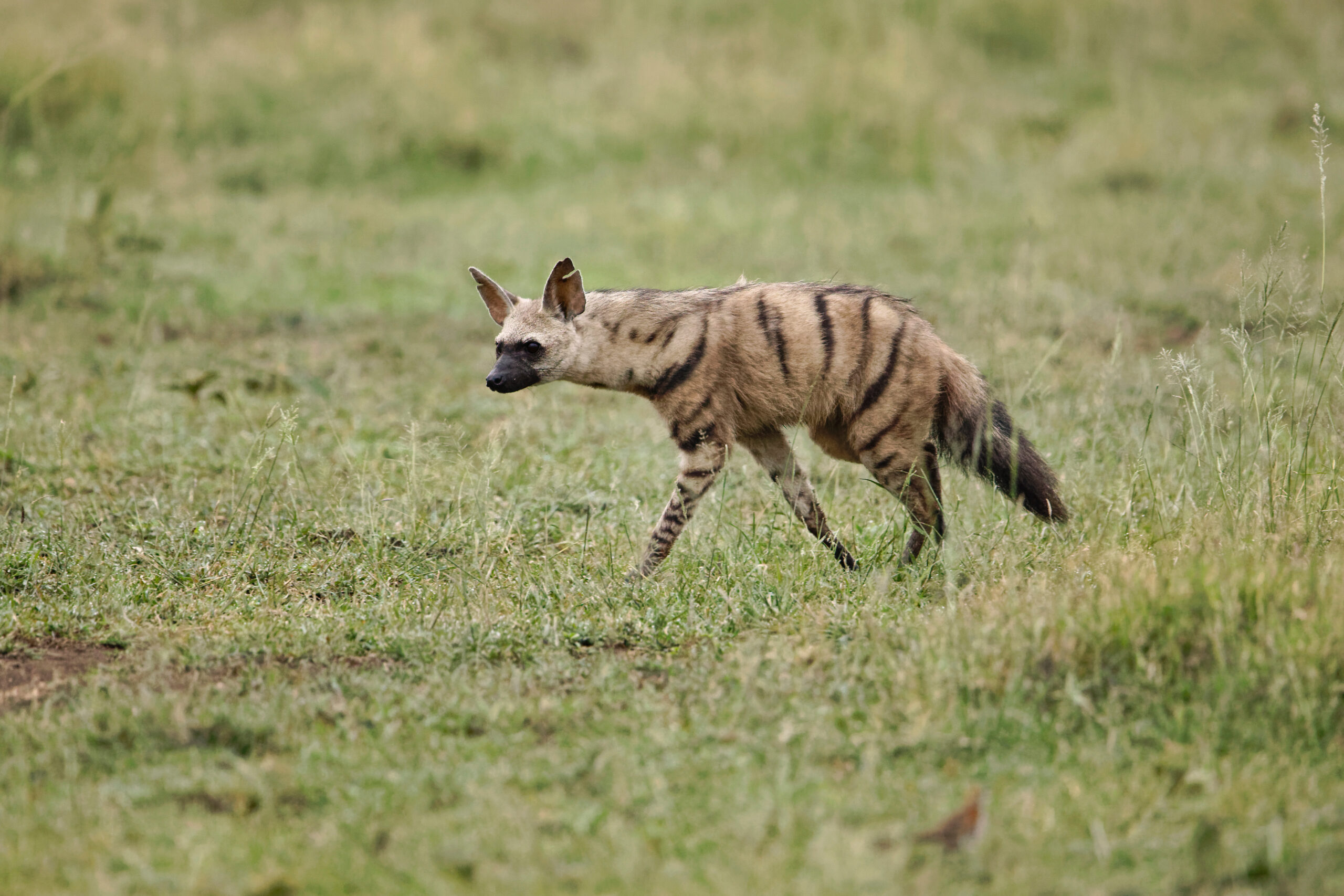
4. Aardwolf (Proteles cristatus)
Appearance: Smallest hyena, with a slender build and striped coat.
Diet: Unlike its relatives, it does not hunt large prey, instead, it feeds almost exclusively on termites and other insects.
Behaviour: Shy, nocturnal, and rarely seen.
Conservation status: Least Concern, though pesticide use threatens its insect prey base.
Hyenas in Tsavo and East Africa
In Tsavo, spotted hyenas are the dominant species, playing a crucial ecological role. By hunting, scavenging, and consuming nearly every part of a carcass, they recycle nutrients back into the ecosystem.
At Tsavo Trust, our work includes monitoring hyenas as part of broader predator conservation. Their presence is a sign of ecosystem health, and by protecting habitats and prey species, we safeguard hyena populations alongside lions, leopards, and wild dogs.
Why hyenas matter
Ecological role: As hunters, they regulate prey populations. As scavengers, they clean the landscape and prevent disease spread.
Cultural perception: Often unfairly vilified as cowardly scavengers, hyenas are in fact intelligent, adaptive, and essential predators.
Conservation threats: Habitat loss, human–wildlife conflict, and prey declines pose risks across Africa.
Hyenas are ancient carnivores with a story stretching from Ice Age Europe’s cave hyenas to the living species roaming Africa today. They are not dogs, nor simply scavengers, but highly adapted predators with unique roles in their ecosystems.
In Tsavo, hyenas remind us that every species, from elephants and lions to often-overlooked carnivores, contributes to the balance of the wild. Protecting them means protecting the intricate web of life that makes Tsavo one of Africa’s last great strongholds of biodiversity.